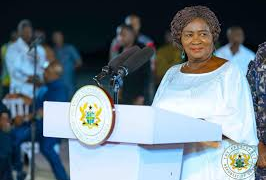







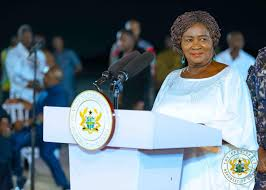
Vice President, Professor Jane Naana Opoku-Agyemang, has described the United Nations’ decision to declare the transatlantic slave trade a grave human rights violation as a significant milestone in confronting historical injustice.
Her remarks came as she joined Chief of Staff Julius Debrah, government officials, traditional leaders, and citizens to welcome President John Dramani Mahama at the airport on Sunday, March 29, following his return from the United Nations where the resolution was adopted.
“It was an honour to join Ghanaians in welcoming you back home following your leadership in securing the historic United Nations resolution recognising the transatlantic slave trade as the gravest crime against humanity,” she stated.
Highlighting the broader implications of the decision, the Vice President noted that the resolution represents more than symbolic recognition.


“This is a consequential moment. It confronts a long-standing injustice and affirms the importance of acknowledging difficult historical periods. It is a recognition of the past, a moral statement, and a challenge to preserve and present this history with accuracy and seriousness,” she said.
She further emphasized Ghana’s role in shaping the global narrative on the issue.
“Ghana has spoken with principle, engaging the history of the African continent and the wider diaspora. This is a proud moment for Ghana and Africa, and a significant one for people of African descent,” she added.
President Mahama, who also serves as the African Union’s Champion for Reparations, described the development as a major step in addressing one of humanity’s darkest chapters.
Speaking upon arrival, he emphasised the broader meaning of the resolution.
“This is a proud moment for Ghana. It is a proud moment for Africa. It is a proud moment for people of African descent wherever they are in the world,” he said.
“This is not just about the past. It is about justice, dignity, and truth,” he added.
The United Nations resolution, introduced by Ghana, was adopted with 123 votes in favour. It formally recognises the transatlantic slave trade—which affected an estimated 12 million Africans and their descendants—as a grave human rights violation.
The move is widely seen as a critical step toward advancing discussions on official apologies, restitution of cultural artefacts, and reparations.
However, the resolution was not unanimously supported, with the United States among three countries that voted against it, citing concerns over its wording and possible legal consequences.
The adoption of the resolution reinforces Ghana’s growing influence in global advocacy on historical justice and reparative dialogue, while signalling renewed international attention to the enduring legacy of the transatlantic slave trade.