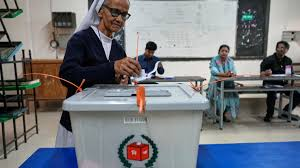







About 127 million eligible voters are expected to cast their vote in Bangladesh’s first election since former Prime Minister Sheikh Hasina’s government collapsed in 2024 after weeks of mass protests, dubbed by many as a Gen Z uprising.
The polls on Thursday marks a defining moment for the country’s democratic trajectory following years of unrest.
Voting began slowly in parts of the capital, Dhaka, but picked up momentum by midmorning as citizens queued at polling stations nationwide. Ballots are being cast throughout the day, with official results anticipated on Friday.
The contest is expected to be closely fought. Tarique Rahman, a key figure in the Bangladesh Nationalist Party (BNP), is widely viewed as a front-runner. The son of former Prime Minister Khaleda Zia, Rahman returned to the country in December after 17 years in self-imposed exile in London. He has campaigned on promises to strengthen democratic institutions, restore the rule of law and revive an economy that has struggled amid prolonged instability.
Opposing the BNP is an 11-party alliance spearheaded by Jamaat-e-Islami, the country’s largest Islamist party. Once banned under Hasina’s administration, Jamaat has re-emerged as a significant political force since her departure. Its rising influence has sparked apprehension among women and minority groups, particularly Hindus, who make up about 8% of the population in a country that is more than 90% Muslim.
After casting his ballot, Jamaat-e-Islami chief Shafiqur Rahman described the election as a watershed moment. “It is a turning point,” he said, expressing confidence that voters were seeking change.
The election is being overseen by an interim administration led by Nobel Peace Prize laureate Muhammad Yunus, which has pledged to ensure transparency and credibility. Approximately 500 international observers and foreign journalists, including representatives from the European Union and the Commonwealth, are monitoring the process.
Bangladesh’s 350-member Parliament comprises 300 directly elected lawmakers from single-member constituencies and 50 seats reserved for women. Members are elected under a first-past-the-post system for five-year terms. Voting in one constituency has been delayed following the death of a candidate.
The election follows a turbulent period marked by political violence, attacks on journalists and Hindu communities, and concerns over the growing clout of Islamist groups. For many voters — especially young people who played a pivotal role in the 2024 protests — this vote represents a chance to reset the country’s political course. About five million citizens are casting ballots for the first time.
“It’s a crucial election because we can finally express our opinions freely,” said 28-year-old voter Ikram ul Haque, who described previous polls as flawed. “We are celebrating it like a festival. I hope it brings real change.”
Beyond electing lawmakers, voters are also weighing in on a proposed reform package born out of a national charter signed by major political parties last year. If endorsed by a majority, the new Parliament would establish a constitutional reform council tasked with implementing sweeping changes within 180 working days.
Among the proposed reforms are the creation of new constitutional bodies and a shift from a unicameral to a bicameral legislature, including the formation of an upper house with authority to amend the constitution by majority vote.


While both the BNP and Jamaat-e-Islami ultimately backed the charter with modifications, Sheikh Hasina’s Awami League party and some of its allies were excluded from the discussions and barred from contesting the polls.
More than 2,000 candidates, including many independents, are vying for 300 seats in the Jatiyo Shangsad, or House of the Nation, with counting by hand beginning soon after polls close at 4.30pm (10:30 GMT) and results expected to be known by the following day.