






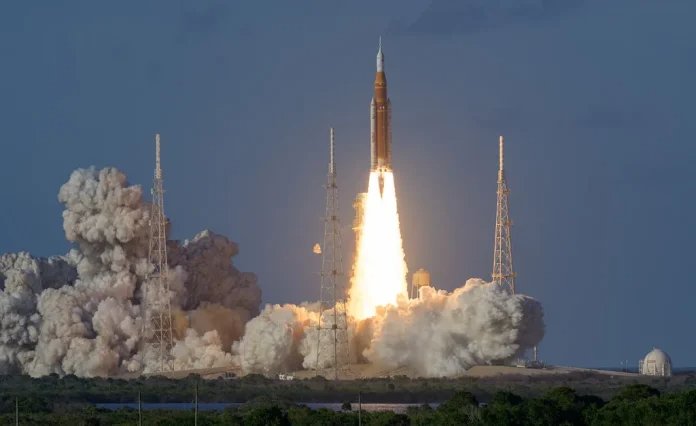
The Artemis II mission is now underway following a successful launch from Kennedy Space Center, marking humanity’s return to deep space after more than five decades.
The mission lifted off on Wednesday from Florida, sending four astronauts on a historic journey around the moon and back—becoming the first crewed mission to travel beyond low-Earth orbit since the Apollo era.
Operated by NASA, Artemis II represents a critical step in the agency’s long-term ambition to land humans on the moon again and eventually push onward to Mars.
The crew—Reid Wiseman, Victor Glover, Christina Koch, and Jeremy Hansen—are embarking on a nearly 10-day mission designed to test the Orion spacecraft’s readiness for deep space exploration.
Moments after liftoff, commander Wiseman confirmed the mission’s trajectory, saying from orbit: “We have a beautiful moonrise, we’re headed right at it.”
The towering 32-storey rocket drew tens of thousands of spectators to the launch site, with excitement building despite earlier technical concerns. Engineers had closely monitored the fueling process, particularly after a hydrogen leak disrupted a previous test. This time, more than 700,000 gallons of fuel were loaded successfully without incident.


Additional issues, including communication glitches with the rocket’s flight-termination system and irregular temperature readings in the Orion capsule’s abort system battery, were resolved ahead of launch, allowing the mission to proceed on schedule.
According to launch director Charlie Blackwell-Thompson, the mission carries global significance. “On this historic mission, you take with you the heart of this Artemis team, the daring spirit of the American people and our partners across the globe, and the hopes and dreams of a new generation. Good luck, Godspeed Artemis II. Let’s go.”
In the coming days, the crew will conduct a series of system checks while orbiting Earth before executing a critical maneuver known as translunar injection, which will send the spacecraft toward the moon.
The Orion capsule is expected to travel behind the moon on a free-return trajectory—using lunar gravity to loop back toward Earth—before re-entering the atmosphere at speeds exceeding 40,000 kilometres per hour and splashing down in the Pacific Ocean.
With decades having passed since humans last ventured this far into space, Artemis II is being framed as a defining mission for a new era of exploration—one that could pave the way for sustained lunar presence and eventual human missions to Mars.