






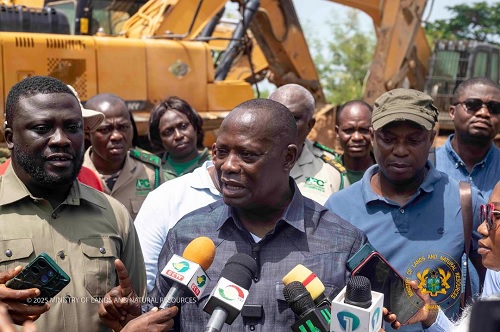
Lands Minister Emmanuel Armah-Kofi Buah has moved to calm rising anxieties over looming job losses at the Abosso Gold Fields Damang Mine, following the government’s refusal to renew the company’s mining lease.
Speaking during a tense but hopeful engagement with mine workers on Friday, the Minister declared unequivocally that the government’s intervention is aimed at protecting livelihoods, not jeopardising them.
“This transition will not affect your jobs — it’s to empower you,” Mr Buah said.
“Contractors and subcontractors who work here must be assured that this transition will not affect their commitments, agreements and contracts that they have here.”
The Damang Mine’s lease officially expired today, April 18, 2025. Gold Fields’ failure to secure a renewal has triggered a seismic shift in the Western Region’s mining landscape, with the state stepping in to assume operational control. The decision, however, has sparked fears of mass layoffs, with over 1,000 direct and indirect jobs at stake.
The government’s stance has already drawn sharp responses from labour groups. The Ghana Mine Workers’ Union (GMWU) has endorsed plans for protests, should jobs be lost in the process.


“If the government doesn’t change its position, we may lose our incomes — and that could force us to march and demand our livelihoods directly,” warned GMWU General Secretary, Abdul-Moomin Gbana.
Gold Fields, in a statement, acknowledged the expiration of its lease and assured that it continues to engage the government to secure “the best outcome for all stakeholders.”
The company has maintained a significant presence in Ghana’s mining industry for decades. Yet behind the public reassurances, frustrations have been mounting over the company’s operational priorities.
Deputy CEO of the Minerals Commission, Isaac Tandoh, accused the company of not following due process in its renewal bid.
“The minister made it clear — we cannot continue business as usual. If they had a better proposal, they should have engaged the Minerals Commission directly, instead of writing letters,” Mr Tandoh said on Joy News’ PM Express Business Edition.
In an unusually candid critique, Andrews Tandoh, also of the Minerals Commission, accused Gold Fields of exploiting Ghana’s mineral wealth without giving back sufficiently to the local economy.
“Last year, Tarkwa and Damang mines made over $600 million in profit. How much of that stayed in the country? Your guess is as good as mine,” he noted.
“Instead of using the profit to develop the Damang mine, they were busy buying mines in Canada and Chile.”
According to Tandoh, Gold Fields has focused on stockpile treatment instead of active mining in recent years — a move he described as a strategy to extract easy cash from Ghana without reinvestment.
“They’ve been taking free cash from Ghana without actually working. And this cannot continue. Ghanaians deserve better,” he said bluntly.
Despite the criticisms, the Lands Minister was keen to reassure the workforce and surrounding communities that the transition would be managed with transparency and compassion.
“Today, we had to come to engage the workers of the Gold Fields Damang Mines to assure them of His Excellency, President Mahama’s commitment to ensure that even in this transitional period, their jobs will be guaranteed,” Mr Buah said.
He added that the government’s vision was not to destabilise operations but to ensure continuity while safeguarding national interest.
“Ultimately, it is to strengthen them, not to weaken anybody. The intention is to empower the communities here and to make sure there is continuity in operations.”
As negotiations continue behind closed doors, Damang and the entire mining community watch closely. What’s at stake is not just a licence — but the economic heartbeat of an entire region.