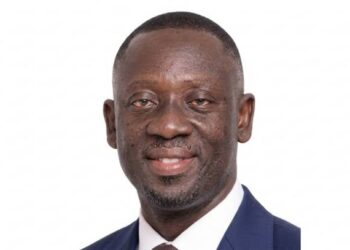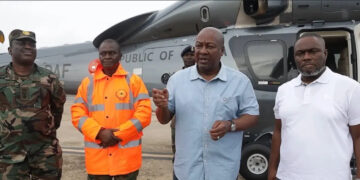







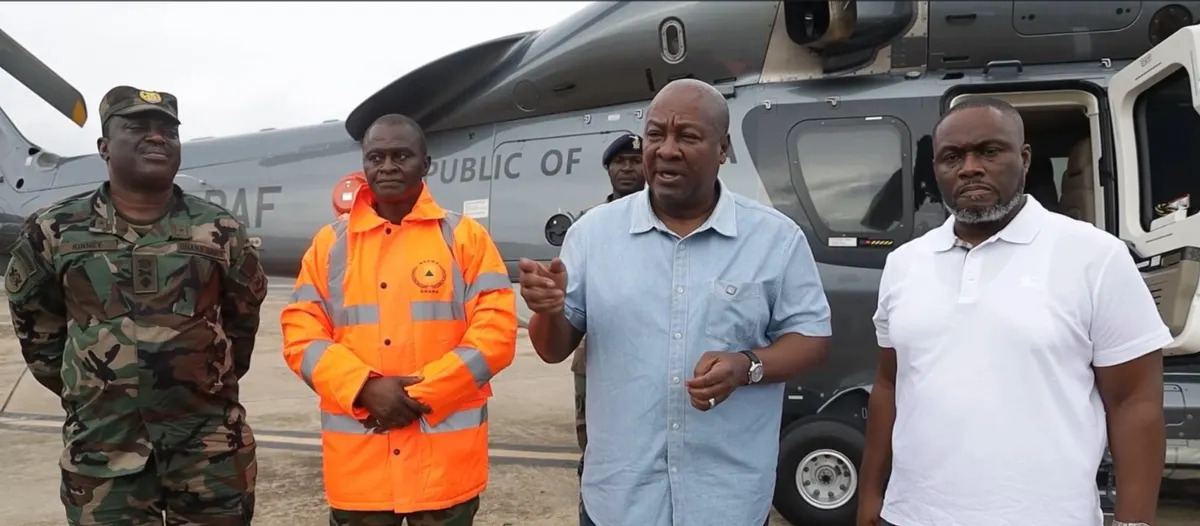
President John Dramani Mahama has commiserated with victims of Monday’s devastating floods in Accra, describing the destruction as extensive after conducting an aerial inspection of some of the worst-hit communities across the capital.
The President expressed sympathy to families who lost loved ones and residents whose homes, businesses and other properties were destroyed by the torrential rains.
Following the assessment, President Mahama directed the Minister of Finance to immediately release funds from the government’s Contingency Fund to support emergency relief efforts for affected residents.
The intervention comes as rescue and recovery operations continue in flood-stricken communities, where at least twelve people have been confirmed dead and hundreds displaced by the disaster.


Addressing the media after the assessment, President Mahama expressed condolences to families who lost loved ones and sympathised with residents whose homes and livelihoods were destroyed.
“I just want to express my sympathy with people who have lost property. Loss of property has been very extensive,” he said.
The President praised the coordinated response by emergency and security agencies, saying their timely intervention helped save many lives during the disaster.
He commended the Ghana Armed Forces, the Ghana Police Service, the Ministry of Works, Housing and Water Resources, the National Disaster Management Organisation (NADMO) and the 48 Engineers Regiment for their rescue operations in flood-affected communities.
“I’ve seen many of the videos where people had to be carried out of their houses. They deployed their boats, and they helped to save quite a lot of lives,” he stated.
Rescue teams were seen navigating heavily flooded neighbourhoods in boats, evacuating children, the elderly and other vulnerable residents trapped by rising floodwaters.
To provide immediate assistance to affected families, President Mahama announced that government, through NADMO, would begin distributing emergency relief while officials continue to assess the full extent of the damage.
“NADMO will do what it can to try and identify the victims and see how we can just support them in a way in the next few days,” he said.
The President further disclosed that he had instructed the Minister of Finance to make emergency funds available without delay.
“I’ve asked the Minister of Finance to release some money from the contingency fund so that we can do some post-flood relief for persons who have been affected.”
The relief package is expected to provide temporary shelter, food supplies, essential household items and other humanitarian support for displaced residents.
While stressing the importance of the emergency intervention, President Mahama maintained that Ghana must move beyond responding to flood disasters after they occur and instead implement lasting measures to tackle Accra’s perennial flooding problem.
“Let me again express my sympathy, but let us change our attitude and let us find a permanent solution to this Accra flooding problem,” he urged.
Using a well-known analogy to emphasise the need for proactive action, the President added:
“We shouldn’t become like the vulture who, anytime it is raining, he says as soon as it stops raining, he will repair his roof. And then as soon as it stops raining, he says, wait, it will stop raining, so there’s no need to repair the roof. This time should be different.”
Monday’s floods once again exposed the capital’s vulnerability to heavy rainfall, with major roads rendered impassable and several residential communities inundated after prolonged downpours.
Areas including Alajo, Kaneshie, Kwame Nkrumah Circle, Adabraka, Weija, Odawna, parts of Tema, East Legon and surrounding communities were among the hardest hit, leaving thousands of commuters stranded and forcing many residents to flee their homes.
Emergency responders continue search, evacuation and recovery operations in the affected areas, while authorities work to restore normalcy.
Urban planning experts have consistently attributed Accra’s recurring floods to poor drainage infrastructure, indiscriminate waste disposal, encroachment on waterways and rapid, unplanned urban development, underscoring the urgent need for long-term interventions.