






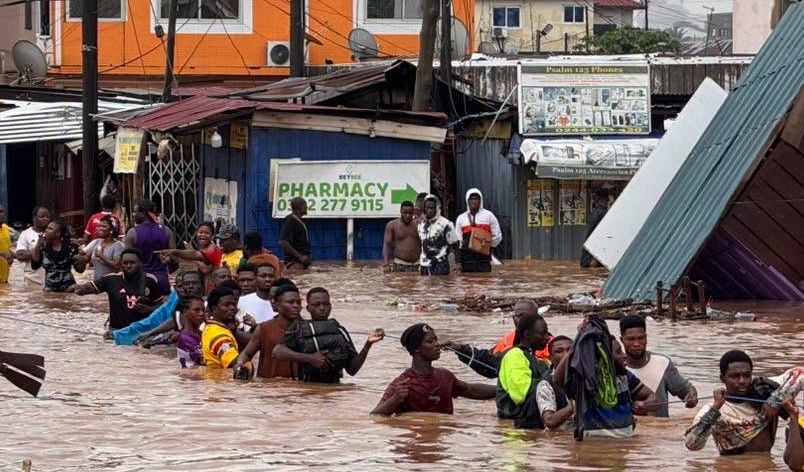
Accra is reeling from one of its most devastating flood events in recent years, with authorities confirming that more than 12 people have lost their lives following hours of torrential rainfall that submerged communities, destroyed property and overwhelmed drainage systems.
Emergency responders are also dealing with a fresh crisis after a building collapse was reported in the Tabora area on Monday evening, prompting a renewed search-and-rescue operation as several people are believed to be trapped beneath debris.
A spokesperson for the Ghana National Fire Service, Alex King Nartey, confirmed that personnel were deployed immediately to the scene to assist in ongoing rescue efforts.
“As I speak to you now there is a building collapse at Tabora, so our personnel are there trying their best to help rescue people from the rubble,” Nartey told broadcaster TV3.
He further disclosed that rescue teams had already evacuated more than 150 people across various flood-affected communities in the capital as operations continued through the day.
The death toll, according to him, has now surpassed 12, though officials caution that the figure could rise as reports of missing persons continue to emerge from multiple locations.
“It looks like there is more and you would be surprised that the death toll could rise because there are a lot of people who are reported missing,” he warned.
Fatalities have been recorded in several parts of the city, including Tema Newtown, Alajo, Achimota Agbogbloshie, Odorna and Abofu, with causes ranging from electrocution to structural collapse and drowning.
Rescue operations have been supported by personnel from the Ghana Armed Forces, the Ghana Police Service, and the National Disaster Management Organisation (NADMO), alongside other emergency agencies working to evacuate stranded residents and secure affected areas.
President John Dramani Mahama, who toured flood-hit communities by air, has ordered an immediate nationwide sweep of drainage systems to remove blockages believed to be worsening the situation.
He has directed Metropolitan, Municipal and District Assemblies, in collaboration with the Ministry of Works, Housing and Water Resources, to identify and clear all obstructions in waterways.
“We’re asking every district to identify, together with the Works and Housing Ministry, where the blockages in the channels are so that we can earmark those places for removal,” the president said.
Mahama stressed that government intervention would not be limited to demolishing structures obstructing drains but would also include the removal of debris to restore proper water flow.
“We’ll not only break the houses. We have to move the rubble out of the way because there’s no use breaking a house and leaving the rubble in the waterways,” he stated.
He also revealed that a long-term urban restructuring plan is being developed to ease pressure on Accra, including the creation of a new growth centre outside the capital and the gradual relocation of key public institutions.
A 20-year development strategy is expected to guide investments in infrastructure, including roads, water and electricity, to reduce congestion in the city.
The president expressed condolences to affected families and praised emergency responders for their ongoing efforts in evacuation and rescue operations, including boat-assisted interventions in submerged communities.


He further directed the Finance Ministry to release funds from the Contingency Fund to support immediate relief for victims.
“This time should be different,” Mahama said, urging stronger public cooperation in maintaining drainage systems and preventing recurring flooding in the capital.