







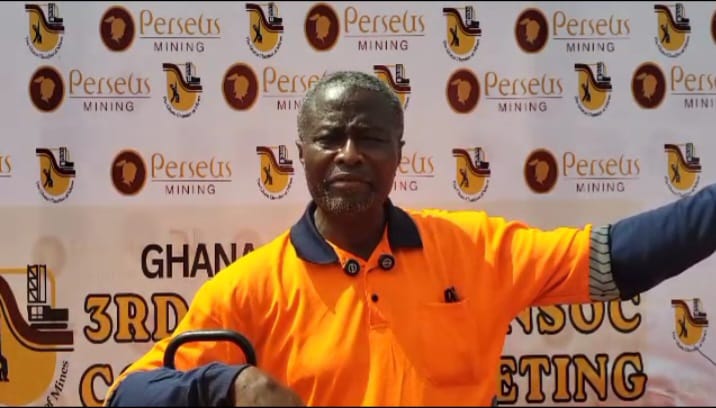
A Chinese-developed Gas Expansion Rock Breaking System has been presented to stakeholders in Ghana’s mining industry as a potential alternative to conventional explosive blasting during a conference organised by the Ghana Chamber of Mines’ Environmental Sector at Perseus Mining Company Limited in the Obuasi-Ayanfuri area.
The presentation was led by mining and construction expert and Chief Executive Officer of Mining and Construction Services, Engineer Andy Augustus Agyemang Amoah, who is championing the introduction of the technology into Ghana’s quarrying and mining industries.
Manufactured by Shanxi Rilong Machinery Equipment Co., Ltd. (Rilon) in China, the system uses gas expansion to break rocks instead of the conventional explosive method.
Engineer Amoah said the technology was being introduced at a time when quarry and mining operators were facing increasing challenges associated with blasting, particularly vibrations, flying rocks and noise as well as the risks posed to communities and structures located close to operational sites.
He said the situation had become more significant because of the increasing encroachment of settlements and other developments around quarry sites, leaving operators with limited space to maintain the wider safety distances normally associated with conventional blasting.
According to Engineer Amoah, one of the key attractions of the Gas Expansion Rock Breaking System is its potential to provide a different approach to rock fragmentation while simplifying aspects of storage, transportation and handling.
He said experience from demonstrations conducted in Ghana had shown that the technology could significantly reduce some of the concerns associated with conventional blasting.
He explained that, whereas conventional blasting generally requires people to remain several hundred metres away from the blast area as a safety precaution, the demonstrations with the new system had allowed personnel to remain much closer to the breaking point without the flying rocks and significant vibrations normally associated with explosive blasting.
Engineer Amoah said the system had already undergone demonstrations at the ESM Quarry at Buoho, Bibiani Mines and the Prestea-Bondae area with the results and observations from the exercises presented to the Minerals Commission as part of ongoing regulatory engagement.
He said the initiative began with training provided by the Chinese technical team, during which he, his workers and blasting technicians underwent an intensive programme to acquire the skills required to operate the system.
He added that with the experience gained from the initial training and field exercises, local operators were now able to learn and handle the technology within a considerably shorter period.
Storage, Cost and Operational Considerations
Engineer Amoah said the physical design of the system also makes it relatively convenient to handle, describing its rock-breaking components as similar in appearance to commonly used plumbing pipes.
He said this characteristic makes storage and transportation less complicated, although the final regulatory requirements for commercial operations would be determined by the relevant authorities.
On cost, Engineer Amoah claimed that the technology could reduce rock-breaking expenditure by about 30 per cent compared with conventional blasting, while stressing that actual savings would depend on the size and nature of the operation.
He said the technology could also reduce some of the logistical requirements associated with conventional explosives, including the arrangements normally necessary for their movement and use.
Positive Industry Response
The presentation at the Ghana Chamber of Mines conference provided an opportunity for mining-sector stakeholders, particularly those within the environmental field, to examine the technology, its operation and its potential application in Ghana.
Engineer Amoah said the response from stakeholders who had participated in or observed the demonstrations had been encouraging, with interest centred on the system’s potential to address some of the safety and community concerns associated with conventional blasting.
He said the next stage would involve further technical assessment, regulatory engagement and industry consultation before the technology could be considered for broader commercial application.
“As we transition from demonstrations to commercial operations, the Minerals Commission will have to determine the appropriate rules and standards to guide the use of the technology in Ghana,” he said.


Engineer Amoah believes wider adoption of modern rock-breaking technologies could support the development of a more adaptable quarrying and mining sector, particularly in areas where conventional blasting has become increasingly difficult because of proximity to communities and other developments.
He said continued testing, professional engagement and regulatory approval would be critical to determining the technology’s future in Ghana’s mining and quarrying industry.
By: Michael Walier