







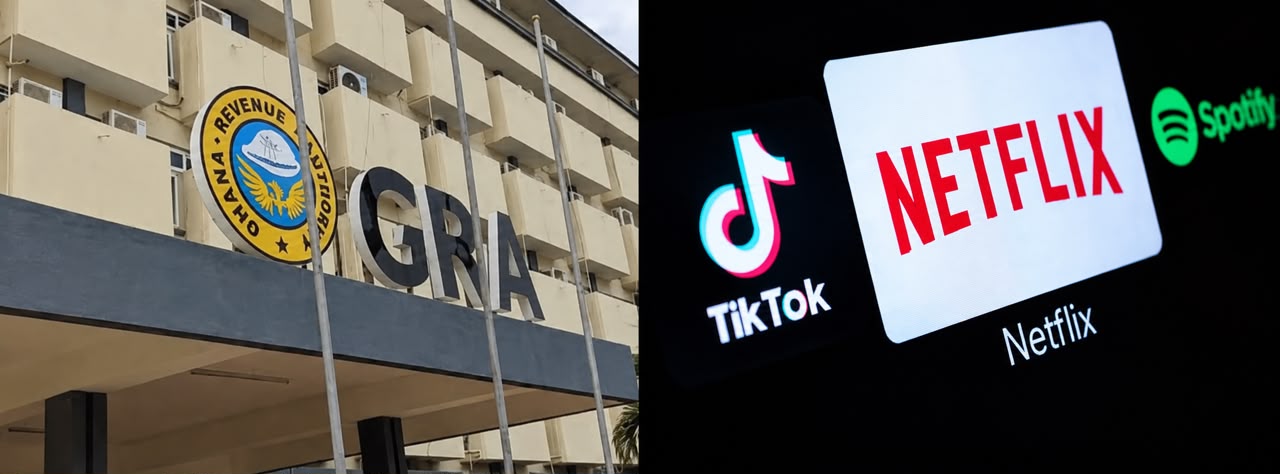
The Ghana Revenue Authority (GRA) has clarified that its new digital Value Added Tax (VAT) collection system will not introduce an additional 20 per cent charge on subscriptions to foreign digital services whose prices already include the applicable taxes.
Commissioner-General of the GRA, Anthony Kwasi Sarpong, said the framework is intended to improve the collection of existing taxes rather than increase the tax burden on consumers using services such as Netflix, Spotify and other online platforms.
Speaking on Joy FM on Wednesday, October 14, 2026, Mr Sarpong explained that the tax component was already included in payments for services covered by the existing arrangement.
“So this system is not adding another 20 per cent to what you already pay. It is already embedded, and consumers are paying,” he said.
He disclosed that the GRA currently receives VAT payments from about 92 foreign service providers, assuring consumers that prices for services offered by these companies would not change as a result of the new collection system.
“Nothing will change in terms of pricing from 92 merchants or entities,” he stated.
However, the Commissioner-General said the Authority had identified approximately 100 additional foreign providers that were not charging VAT and would gradually bring them into the tax collection framework.
The clarification comes as commercial banks prepare to apply a 20 per cent tax on payments for qualifying cross-border digital services and e-commerce transactions made with payment instruments issued in Ghana.
Standard Chartered Bank has informed its customers that it will begin applying the tax to payments for cross-border digital services made with its Ghana-issued cards from October 15, 2026, citing GRA requirements.
The full scope of the directive and the extent to which individual services will be affected remain unclear.
How the New Collection System Works
Mr Sarpong explained that the existing system relies on foreign digital service providers to declare their transactions and remit the applicable taxes to the GRA.
According to him, this arrangement limits the Authority’s ability to independently verify the volume and value of transactions conducted by consumers in Ghana.
Under the new framework, the tax component will be separated from the payment when a customer pays for an eligible service. The relevant amount will be transferred to the government, while the balance will go to the service provider.
Using Netflix as an example, he explained how the system would facilitate the collection of the government’s share directly at the point of payment.
“We are using technology to smartly account for and collect the component that belongs to the government of Ghana,” he said.
The system is also expected to give the GRA better visibility into the number and value of transactions and the corresponding taxes due, reducing its reliance on information submitted by foreign companies.
Digital Services Covered
The framework applies to qualifying electronically supplied services provided by non-resident companies and paid for using Ghana-issued payment instruments.
These include bank cards, mobile money accounts and digital wallets.
Potentially affected services span several categories, including digital entertainment, software subscriptions, cloud computing, online gaming, digital advertising and other internet-based services.
Platforms in these categories include Netflix, Spotify, Disney+, Zoom, Microsoft, Google Workspace, Amazon Web Services, TikTok Ads and Meta Ads.


Other services, including online education platforms, software security subscriptions and certain online travel and hospitality transactions, may also fall within the framework, depending on their classification and the applicable tax treatment.
The complete list of affected services and the treatment of individual transactions have yet to be confirmed.
What Customers Should Know
The combined 20 per cent charge comprises 15 per cent VAT, a 2.5 per cent National Health Insurance Levy and a 2.5 per cent GETFund Levy.
For services already accounting for these taxes, the new collection arrangement is not expected to introduce another 20 per cent charge.
However, customers using Ghana-issued cards to pay foreign providers that have not been charging the applicable taxes could face higher costs as those providers are brought into the collection system.
Customers may also continue to incur existing bank transaction charges, where applicable.
The GRA’s clarification follows the introduction of its Real-Time VAT framework, which seeks to collect the applicable taxes on qualifying cross-border digital services at the point of payment through participating financial institutions.