






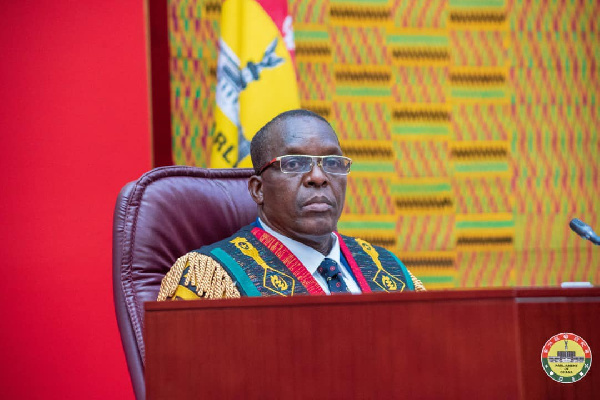
The Speaker of Parliament, Alban Bagbin, has questioned the continued heavy funding of the Office of the Special Prosecutor (OSP), arguing that the institution has failed to deliver meaningful outcomes since its establishment.
Speaking on the floor of parliament on Thursday, December 4, 2025, the Speaker expressed concern over what he described as poor returns on the significant investments made in the anti-corruption office.
According to him, Parliament initially supported the creation of the OSP not because it had a constitutional foundation, but because lawmakers wanted to send a strong signal to the world that Ghana was committed to fighting corruption. However, years down the line, he said the country had little to show for the huge sums allocated to the office.
“There are some agencies—this morning, I heard you talking about one of them, that is the OSP. And if you recall, during the deliberation on the OSP, a number of us stated on the floor of this House that there’s no constitutional basis, but we wanted to signal to the world that we are going to fight corruption,” he said.
The Speaker stressed that Parliament could no longer justify pouring scarce national resources into an institution that has not demonstrated measurable impact. “At the end of the day, we have seen the results, and we cannot continue to allocate huge sums to the same office when we are not getting results,” he added.
He further noted that the OSP continues to receive funding nearly equivalent to that of the Attorney-General’s Department, despite the AG’s office being responsible for the bulk of prosecution work in the country. “This is one of the agencies we should be looking at. It is getting almost the same amount as the Attorney General’s Department,” he emphasized.
Calling for decisive action, the Mr. Alban Bagbin urged the House to confront the issue head-on. “Please, let’s face the bull by the horns and make sure the right thing is done. And so I agree with the Majority Leader… the Minister for Finance should be apprised of these discussions,” he stated.
The Speaker reiterated that Parliament has a duty to act in the interest of Ghanaians by ensuring accountability and value for money. “It’s very, very important that as a House, we cannot continue to be failing the good people of Ghana. If we do our work well, we’ll be able to curb corruption,” he said.


He added that effective oversight of public institutions is essential to maintaining public trust. “We’ll be able to hold the executive to account for its stewardship, not only in terms of money but in terms of the trust that the people repose in leadership.”
The Speaker’s remarks echo earlier concerns raised by Majority Leader Mahama Ayariga, who recently called for the abolition of the OSP. Mr. Ayariga argued that corruption cases should be handled solely by the Attorney-General’s Office, noting that despite receiving substantial funding, the OSP has consistently failed to produce results, unlike the under-resourced AG’s Department.
With the Speaker’s comments adding to the reigniting national debate over the relevance and effectiveness of the Special Prosecutor’s Office, the future of Ghana’s flagship anti-corruption body now hinges on whether it can deliver tangible results and restore public confidence in the country’s fight against corruption or face growing calls for its dissolution.