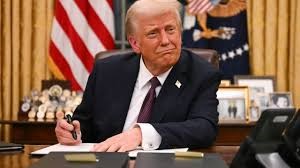







U.S President Donald Trump has announced an increase in a temporary tariff rate on imports from all countries, raising it from 10% to 15%, less than 24 hours after the Supreme Court of the United States ruled against the legality of his flagship trade policy.
The 6-3 decision by the apex court found that Trump had exceeded his authority by imposing tariffs last year under the International Emergency Economic Powers Act (IEEPA) without congressional approval. The ruling effectively struck down the administration’s use of emergency powers to justify sweeping import duties.
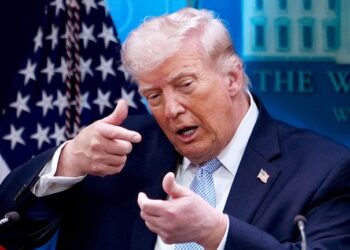
In response, a visibly angered Trump sharply criticized the justices, describing them as a “disgrace to the nation,” and swiftly ordered a fresh 10% tariff on all imports under a different statute. By Saturday, he had gone further, invoking Section 122 of the Trade Act of 1974 to raise the rate to 15%.
Announcing the decision on his Truth Social platform, Trump declared:
“I, as President of the United States of America, will be, effective immediately, raising the 10% Worldwide Tariff on Countries, many of which have been ‘ripping’ the U.S. off for decades, without retribution (until I came along!), to the fully allowed, and legally tested, 15% level.”
Section 122 of the 1974 Trade Act — a provision that has never previously been used — allows a president to impose tariffs of up to 15% for 150 days without congressional approval. Beyond that period, lawmakers must sign off on any extension. Trump indicated that within the 150-day window, his administration would work to develop new and “legally permissible” tariffs to replace those struck down by the court.
Although Trump said the increase would take effect “immediately,” it remained unclear when the new 15% rate would be formally implemented. A White House fact sheet had earlier indicated that the initial 10% tariffs announced on Friday were scheduled to take effect on February 24 at 12:01 a.m. Washington time. The White House and the U.S. Trade Representative’s office did not immediately respond to requests for comment.
The president is moving swiftly to preserve his broader trade agenda after the court rejected his use of emergency powers to impose what he has described as reciprocal tariffs around the world. Hours after the ruling, Trump imposed a 10% global tariff on foreign goods, arguing the measures were critical to U.S. economic and national security interests.
However, his Saturday announcement made clear that he now considers the 10% rate insufficient, despite having said just a day earlier, “Every single thing I said today is guaranteed certainty.”


The rapid shifts underscore the economic volatility surrounding the administration’s trade policy. While Section 122 provides a legal pathway for temporary tariffs, the authority is narrower and could face fresh legal scrutiny. Securing congressional backing for any longer-term measures may prove difficult, as Democrats and some Republicans have voiced opposition to elements of Trump’s trade approach.
On Tuesday, Trump will face those lawmakers, as well as members of the Supreme Court, as he delivers the State of the Union address to Congress in Washington. The primetime speech is expected to focus on his economic policies as Republicans try to land on a midterms message for an electorate that is frustrated by prices and the cost of living.