






The United Kingdom and France have reached an agreement to deploy military troops to Ukraine in the event of a peace deal with Russia.
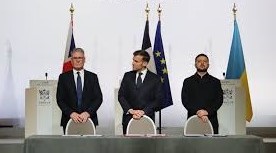
The decision was reached after officials from 35 countries met in Paris for talks under the so-called Coalition of the Willing. At the meeting, Starmer and French President Emmanuel Macron signed a “declaration of intent” outlining plans for British and French troops to operate on Ukrainian soil if a ceasefire agreement is achieved — a move Moscow has consistently opposed.
Speaking at a joint news conference alongside European leaders, US special envoy Steve Witkoff and Jared Kushner, son-in-law of President Donald Trump, Starmer said the two countries would play a central role in safeguarding Ukraine once hostilities end.
“Following a ceasefire, the UK and France will establish military hubs across Ukraine and build protected facilities for weapons and military equipment to support Ukraine’s defensive needs,” Starmer stated.
The Paris meeting, the largest since the coalition was formed last spring, took place against the backdrop of heightened global tensions, including recent US military action in Venezuela and renewed statements from the Trump administration asserting interest in Greenland, an autonomous territory of Denmark. Those developments had raised concerns among analysts about Washington’s reliability as a long-term security guarantor for Ukraine, particularly given Denmark’s NATO membership.
Despite those concerns, Witkoff reassured allies that the Trump administration remains committed to ending the nearly four-year war in Ukraine.
“We’re determined to do everything possible to bring peace to Ukraine,” he said, adding that “a lot of progress” had been made in Paris. He noted that security protocols were close to completion to ensure that “when this ends, it ends forever.”
NATO Secretary-General Mark Rutte also welcomed the outcome of the meeting, describing it as “very successful.” He expressed confidence that the proposed security guarantees would prevent future Russian attacks on Ukraine.
“If this gets into place, then Putin will never, ever try again to attack Ukraine,” Rutte said.
There was no immediate response from Moscow. However, the Kremlin has repeatedly warned it would not accept foreign troops in Ukraine under any peacekeeping arrangement. Russian President Vladimir Putin said last September that Western forces operating in Ukraine would be considered “legitimate targets.”
Under the joint statement issued by the Coalition of the Willing, security guarantees would include a “continuous, reliable ceasefire monitoring system” led by the United States and supported by partner nations. The coalition also agreed to provide Ukraine with long-term military assistance and armaments, alongside deploying a multinational force to secure the country “in the air, at sea and on land.”
Macron said the agreement establishes a clear legal framework for the deployment of British and French forces, strengthening earlier political commitments.
“These security guarantees are essential to ensure that a peace agreement never becomes a Ukrainian surrender or creates a new threat to Ukraine,” the French president said, citing Russia’s history of violating peace agreements with its neighbors.


The coalition also pledged to supply Ukraine with “all the necessary resources” to sustain an armed force of up to 800,000 troops. This marks a shift from an earlier draft peace plan circulated in November, which proposed capping Ukraine’s military at 600,000 personnel, a proposal Kyiv rejected as overly favorable to Moscow.
While Tuesday’s agreement offers a clear picture of how Ukraine’s allies intend to secure the country after a ceasefire, officials acknowledged that a final peace deal with Russia remains uncertain and elusive.