






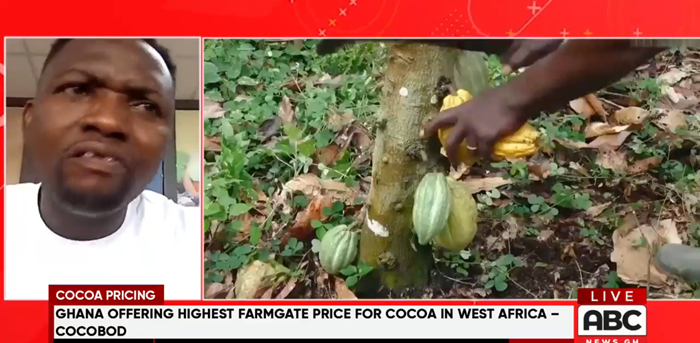
A fresh debate has erupted within Ghana’s cocoa sector as farmers and cooperatives question why, despite official claims of offering the highest farmgate prices in West Africa, Ghana appears to be losing ground to its neighbour Côte d’Ivoire.
The President of Ghana Cooperative Cocoa Farmers Association Issifu Issaka, has raised concerns about the pricing structure, accusing authorities of hiding behind technicalities while farmers continue to feel disadvantaged.
Speaking to ABC Midday News, Mr. Issaka queried: “Why the comparison? Farmers in Côte d’Ivoire are receiving higher prices than Ghana. In Ghana, COCOBOD is centralized where they are the only agency that can sell cocoa to any person that wants to buy cocoa. It is unfortunate to defend some of these things.”
He argued that Ivorian farmers have direct access to traders, allowing them to negotiate better deals on the open market, unlike Ghanaian farmers who are tied to a state-controlled system.
His comments stand in sharp contrast to recent assertions by the Ghana Cocoa Board (COCOBOD), which insists that Ghana currently offers the highest farmgate price in West Africa.
On August 20, COCOBOD issued a statement refuting claims that Ghanaian farmers earn less than Ivorians, stressing that Ghana pays ₵3,228.75 per 64kg bag (₵51,660 per tonne or US$5,040/MT).
This, the Board said, is far higher than Côte d’Ivoire’s ₵2,553.38 per bag (₵40,854 per tonne or US$3,886/MT).
According to COCOBOD, Ghanaian farmers are receiving ₵675.38 (US$64.16) more per bag and ₵10,806 (US$1,154) more per tonne than their Ivorian counterparts.
COCOBOD further argued that Ghana’s pricing policy is designed not only to compensate farmers fairly but also to shield them from currency fluctuations and to curb the menace of cross-border smuggling.
It added that these measures ensure stability in Ghana’s cocoa sector and guarantee farmers predictable income, unlike in Côte d’Ivoire’s liberalized market where prices are vulnerable to the volatility of global commodity traders.
But the Ghana Cooperative Cocoa Farmers Association insists that the lived realities of farmers tell a different story.
They argue that while official figures may suggest higher payments, structural barriers and the centralized system continue to suppress farmer benefits in practice.


“Farmers in Côte d’Ivoire have direct access to traders and are able to negotiate better because they are not centralized. Farmers are receiving higher prices than in Ghana.” Issaka noted.