






The government has initiated moves to rename the National Intelligence Bureau (NIB) to the Bureau of National Intelligence (BNI) as part of sweeping reforms captured in the proposed Security and Intelligence Agencies Bill, 2025.
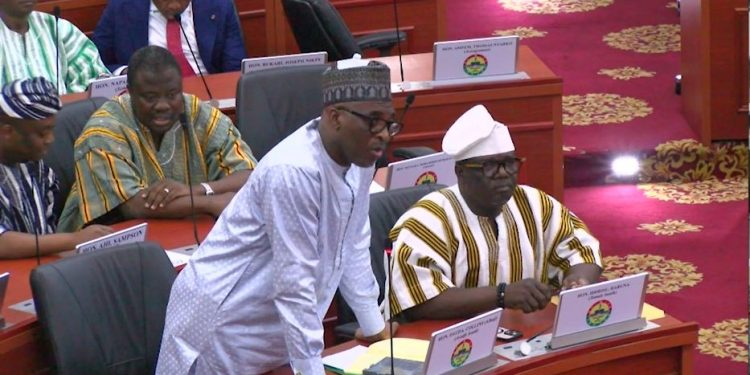
Presenting the rationale behind the proposed amendment on the floor of Parliament on Thursday, February 19, 2026, the Minister for the Interior, Mohammed Mubarak Muntaka, said the change is intended to eliminate persistent public confusion associated with the current acronym.
According to him, the abbreviation “NIB” is frequently mistaken for the National Investment Bank, creating ambiguity that undermines clarity within the country’s security framework.


“Everywhere in the world, you make sure that the acronyms for the security agencies do not match any other thing, and in fact, it is supported by law to make sure that nobody is able to name anything after an acronym of any of the security agencies,” he stated.
“Unfortunately, we have a situation where, when you say NIB, people are wondering whether you’re talking about the bank or you’re talking about the security agency. So Mister Speaker, one of the significant things that we are trying to do is to reintroduce the name BNI at this time, even though the BNI of yesterday was Bureau of National Investigation, this BNI will still remain Bureau of National Intelligence.”
The proposed legislation, beyond the rebranding, also seeks to abolish the position of Minister for National Security as part of a broader restructuring of Ghana’s security architecture.
Under the Bill, the President will instead designate a minister to exercise oversight responsibility over the National Security Coordinator, rather than maintain a dedicated ministry for national security. Mr. Muntaka explained that the reform is aimed at addressing overlaps and potential conflicts in roles within the security establishment.
“…A detailed ministerial role and the function of the national security coordinator, because he’s supposed to coordinate all the activities within the space. And if you assign or leave a ministry called Ministry of National Security that likely is supposed to play an oversight role, and if you are not careful, they begin to conflate, and they begin to have misunderstandings, and that affects the security architecture that we have in the country.
“So one of the things that we are trying to do is to keep this position as more or less of that of the President, and then he gets one of his ministers to play that oversight without the necessarily fine, detailed designation of a minister for national security, so that as much as possible you try to avoid the conflict between the minister and the National Security Coordinator”.
However, the Minority has pushed back strongly against the proposed reforms. Minority Leader Alexander Afenyo-Markin questioned the basis for the changes, arguing that the memorandum accompanying the Bill does not justify an overhaul of the current framework.
“The memorandum before us does not provide any empirical evidence to suggest that ACT 1030 has failed. It appears that this bill is more founded on partisan political interest than a national security interest for good governance,” he argued.
He further expressed concern over what he described as the concentration of authority in the office of the National Security Coordinator.
“What is being proposed? So much power is being given to the coordinator, it is not clear how his powers are going to be fettered and Mister Speaker. My submission is that if you give such powers to the coordinator, and you do not provide for a clear path of responsibility, accountability and oversight, it becomes problematic to you yourself as a government, and when the rights of citizens are being abused, the man will come and tell you that in the name of national security. There will be the need for the Minister to sit with us as a House, do further winnowing and incorporate the major concerns raised by the Minority on this floor.”
Debate on the Bill is expected to continue as Parliament scrutinises the proposed restructuring of the country’s intelligence and security framework.