






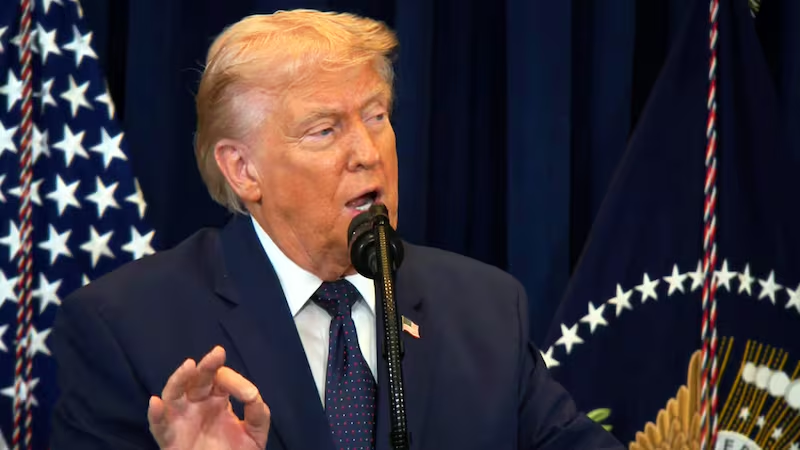
US President Donald Trump has hinted that the ongoing conflict involving Iran could end soon, though he stopped short of providing a clear timeline for when hostilities might cease.
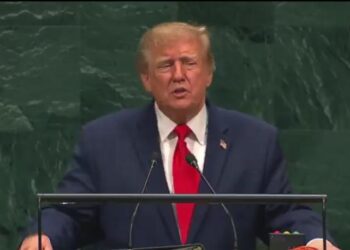
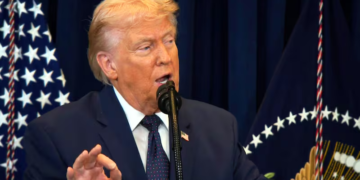
Speaking at a wide-ranging press conference at his Mar-a-Lago estate on March 9, Trump told reporters that the war could conclude soon but emphasized that the fighting is not over yet.
“I think soon. Very soon,” Trump said when asked whether the conflict could end within days or weeks.
Earlier in comments to broadcaster CBS News, the US president suggested the military campaign was close to completion.
“I think the war is very complete, pretty much,” Trump said in a phone interview, adding that Iran’s military capabilities had been significantly weakened.
“They have no navy, no communications. They’ve got no air force,” he said. “Their missiles are down to a scatter. Their drones are being blown up all over the place, including their manufacturing of drones. If you look, they have nothing left. There’s nothing left in a military sense.”
Trump said the US-Israeli offensive against Iran had progressed much faster than initially expected. According to him, the campaign is already well ahead of the original timeline of about four to five weeks.
However, speaking later at his Doral National golf club near Miami, the president appeared to offer a more cautious assessment, saying that although significant progress had been made, the conflict had not yet fully ended.
“Everything they have is gone including their leadership,” he said, while stressing that Washington still wants to ensure Iran cannot develop nuclear weapons for “a very long period of time.”
Despite suggesting the war could end soon, Trump warned that the United States still has the capacity to strike additional targets inside Iran if necessary. He said some of the “most important” sites — including Iran’s electrical grid — had been deliberately left untouched for potential future operations.
The president also issued a stark warning to Tehran against disrupting global oil supplies through the Strait of Hormuz, a critical maritime route for global energy shipments.
“And if Iran does anything to do that, they’ll get hit at a much, much harder level,” Trump said. “We will hit them so hard that it will not be possible for them or anybody else helping them to ever recover that section of the world, if they do anything.”


Even as the conflict escalated, Trump repeatedly downplayed its scale, referring to the campaign as an “excursion” rather than a war. The operation, which began on February 28 with US-Israeli strikes on Iranian targets, has not been formally approved by the US Congress.
The administration has also faced criticism over mixed signals about its long-term objectives in Iran, including whether it seeks full regime change.
Iran’s political leadership has been in flux following the death of Supreme Leader Ali Khamenei, with his son Mojtaba Khamenei reportedly selected as his successor. Trump declined to say whether the new leader was a potential military target.
“It’s not good,” he said of Mojtaba Khamenei’s appointment, while adding that he would prefer an “internal” candidate rather than an external figure.
Trump also disclosed that he had spoken with Russian President Vladimir Putin about both the Iran conflict and the war in Ukraine.
“He wants to be helpful,” Trump said of the Russian leader.
Financial markets reacted positively after Trump’s earlier remarks suggested the conflict might end sooner than expected. Oil and stock markets briefly rallied on expectations that tensions in the Middle East could ease.
Trump nonetheless suggested that while significant gains have been made, the campaign has not yet secured what he views as a complete victory.
“We’ve already won in many ways, but we haven’t won enough,” Trump said.