






The Mental Health Authority (MHA), in collaboration with key stakeholders has called on parents, guardians and communities to be vigilant as emerging innovative forms of substance use and drug abuse continue to threaten the health, safety and future of young people across Ghana.
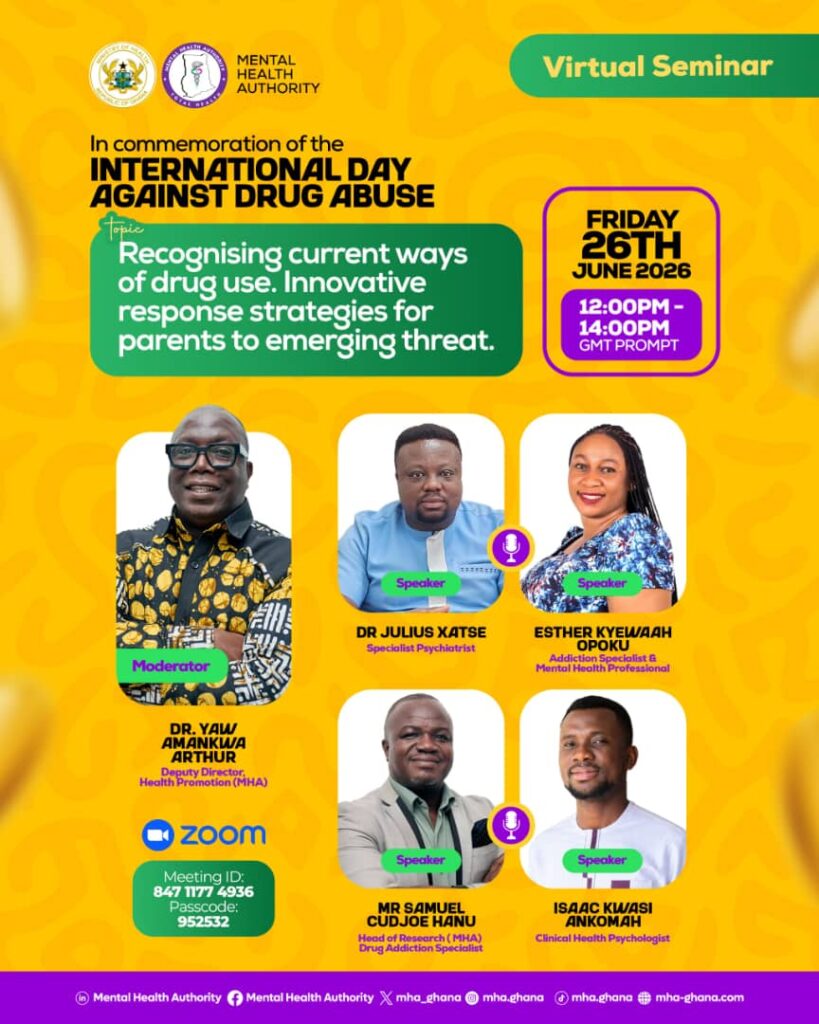
The call was made during a virtual seminar held on Friday, June 26, 2026, to commemorate the International Day Against Drug Abuse. The seminar, held under the theme, “Recognising Current Ways of Drug Use: Innovative Response Strategies for Parents to Emerging Threats,” brought together psychiatrists, psychologists, addiction specialists, researchers, educators, parents, students and members of the public to examine evolving patterns of substance abuse and discuss practical strategies for prevention, early intervention and recovery.
Moderated by the Deputy Director of Health Promotion at the Mental Health Authority, Dr. Yaw Amankwa Arthur, the seminar featured presentations by Dr. Julius Xatse, Specialist Psychiatrist; Esther Kyewaah Opoku, Addiction Specialist and Mental Health Professional; Mr. Samuel Cudjoe Hanu, Head of Research at the Mental Health Authority and Drug Addiction Specialist and Isaac Kwasi Ankomah, Clinical Health Psychologist.
Addressing participants, Esther Kyewaah Opoku revealed that illicit drugs are increasingly being disguised in ordinary products commonly consumed by children and adolescents making detection much more difficult for parents and teachers.
She explained that substances are now being mixed into soft drinks, popcorn, cakes, biscuits, toffees and even salads exposing children to drugs at increasingly younger ages sometimes even before adolescence.
According to her, peer pressure, low self-esteem and the desire to belong to particular social groups continue to drive many young people into experimenting with drugs.
Ms. Opoku also expressed concern over the growing connection between drug addiction and gambling among the youth, describing the widespread availability of drugs as a major public health concern.
She advised parents not to respond with anger or condemnation when they discover their children are using drugs but rather remain calm, engage them in honest conversations and seek to understand the underlying causes before pursuing appropriate professional support.
“No parent wishes to see their child abuse drugs but shouting or threatening them often worsens the situation,” she noted, adding that addiction is treatable and that every young person deserves the opportunity to recover with the right care and support.
Speaking on emerging drug trends, Mr. Samuel Cudjoe Hanu disclosed that young people are increasingly finding creative ways to consume drugs while avoiding detection.
He said some adolescents now inhale glue and other dangerous substances while flavoured cigarettes and vaping devices disguised as pens, markers and other everyday objects have become increasingly common.
Mr. Hanu further revealed that some young people deliberately use strong perfumes and body sprays to conceal the smell of drugs after consumption making it more difficult for parents and guardians to identify possible substance abuse.
He explained that experimentation is often influenced by curiosity, emotional distress, peer pressure, social acceptance and the desire to escape personal challenges.
He therefore urged parents to remain observant, maintain close relationships with their children and create an environment where young people feel comfortable discussing their struggles without fear of punishment.
Clinical Health Psychologist, Isaac Kwasi Ankomah stated that many young people do not abuse drugs because they are inherently bad but because they are searching for acceptance, confidence, emotional relief, improved sleep or a sense of belonging.
He warned that modern vaping devices are now manufactured to resemble flash drives, pens, markers and other common items, making them almost impossible to recognise without proper awareness.
Mr. Ankomah also highlighted the increasing influence of digital platforms and social media, where young people are exposed to drug-related content and unhealthy peer networks.
He identified several behavioural changes that may signal possible substance abuse including sudden changes in friendship circles, declining academic performance, persistent mood swings, red eyes, slurred speech, unusual body odour, changes in eating and sleeping habits, social isolation and increasing disciplinary problems.
He however cautioned that no single behaviour should automatically be interpreted as evidence of drug use, explaining that professionals rely on a combination of behavioural indicators before making any assessment.
For his part, Specialist Psychiatrist Dr. Julius Xatse described addiction as a disease that affects the brain and requires medical attention, professional care and family support rather than blame or condemnation.
He explained that repeated use of addictive substances changes the brain’s reward system, creating powerful cravings that make it increasingly difficult for affected individuals to stop using drugs.
According to Dr. Xatse, while not everyone who experiments with drugs becomes addicted, repeated use significantly increases the risk of dependence.
He encouraged parents to build trusting relationships with their children through love, attention and open communication, stressing that early intervention remains one of the most effective ways of preventing addiction.
Dr. Xatse also advised families against exposing children struggling with substance abuse to unnecessary public ridicule or involving too many people in their personal challenges, as doing so may deepen stigma and discourage them from seeking help.
He further observed that parental denial remains one of the greatest obstacles to early intervention, with many parents unwilling to accept that their children could become involved in substance abuse despite obvious warning signs.
The experts collectively called for stronger collaboration among parents, schools, healthcare professionals, religious institutions, civil society organisations and government agencies to tackle the growing complexity of drug abuse in Ghana.
They further recommended a comprehensive national response anchored on stronger legislation, effective policy implementation and sustained public education to address the country’s evolving rising drug challenge. An important suggestion was needed to increase the numbers of clinical psychologists and counsellors in the schools to be the first point of professional help.
According to the speakers, while law enforcement remains critical in disrupting the production, trafficking and distribution of illicit drugs equal attention must be given to prevention, early intervention treatment, rehabilitation and the successful reintegration of individuals recovering from substance use disorders.
The speakers also advocated practical harm reduction strategies aimed at minimising the health and social consequences associated with drug abuse. These include expanding access to counselling, mental health services, rehabilitation programmes and community based support systems particularly for children and young people who are most vulnerable. They stressed that reducing stigma surrounding addiction would encourage more individuals and families to seek professional help early while improving treatment outcomes.
Participants were encouraged to create supportive home environments where children could can openly discuss personal challenges without fear of judgement, while parents were urged to seek professional assistance whenever signs of substance misuse are observed.
The virtual seminar formed part of activities marking the 2026 International Day Against Drug Abuse and reaffirmed the Mental Health Authority’s commitment to promoting mental well-being, preventing substance abuse and strengthening public education on emerging drug-related challenges.
The Authority further called on all Ghanaians to support national efforts aimed at reducing drug abuse and building healthier, safer and more resilient communities for present and future generations.


By: Michael Walier