






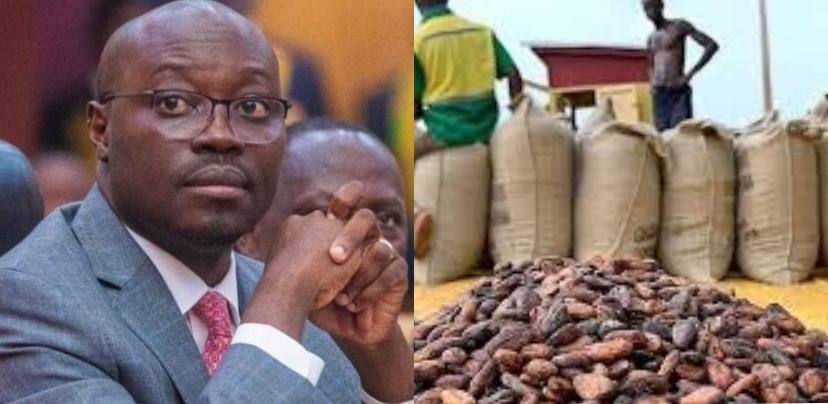
The Minister for Finance, Dr. Cassiel Ato Forson, has announced a reduction in Ghana’s cocoa producer price alongside a series of sweeping reforms aimed at stabilising the country’s troubled cocoa sector.
Addressing journalists at the Government Accountability Series on Thursday, February 12, 2026, Dr. Forson said Cabinet took the decision at an emergency meeting on February 11 after reviewing what he described as deep-rooted structural and financial challenges facing the industry.
The 2025–2026 cocoa season, which began in August last year, initially set the producer price at GH¢51,660 per tonne. This was based on 70 per cent of the gross Free on Board (FOB) price of US$7,200 per tonne. However, developments in neighbouring Côte d’Ivoire soon complicated the situation.
According to the Minister, Côte d’Ivoire subsequently set its producer price about 20 per cent higher than Ghana’s, triggering fears of cross-border smuggling.
“This decision, by the Ivorians, coupled with movement in the exchange rate resulted in a significant difference in the producer price,” he said.
In response, Ghana’s Producer Price Review Committee (PPRC) revised the farmgate price upward to GH¢58,000 per tonne in October 2025. But the upward adjustment proved unsustainable as global market conditions shifted.
Dr. Forson explained that international cocoa prices began falling sharply toward the end of 2025, dropping below US$6,400 per tonne — an estimated benchmark cost for transporting cocoa from farms to ports.
“The current situation is largely driven by the unwillingness of buyers to purchase Ghana’s cocoa because it has become uncompetitive and very expensive,” he explained.
He attributed the worsening crisis to liquidity constraints and weaknesses in the post-syndicated loan financing model adopted by COCOBOD. Between 2022 and 2024, the cocoa regulator’s financial health deteriorated significantly, leading to loan defaults and heavy losses linked to rollover contracts.
In the 2023/2024 crop season, COCOBOD projected output of 800,000 tonnes but managed to produce only 432,145 tonnes — a shortfall of more than 45 per cent. The deficit, Dr. Forson noted, had severe financial consequences.
“This resulted in a huge rollover contract of about 333,767 tonnes… and a loss of over US$1 billion,” he stated.
He further revealed that COCOBOD defaulted on a US$70 million bridge loan from the Ministry of Finance in 2024, compounding its debt challenges.
Against this backdrop, Cabinet has endorsed a comprehensive reform package. Key among the measures is the immediate settlement of arrears owed to cocoa farmers and the introduction of a new COCOBOD Bill that will guarantee at least 70 per cent of gross FOB revenue to producers. The reforms will also establish an automatic producer price adjustment mechanism and introduce a new financing framework built around domestic cocoa bonds.
Other interventions include reviving indigenous licensed buying companies, restructuring the Produce Buying Company (PBC), and revitalising the state-owned Cocoa Processing Company (CPC).
As part of efforts to boost local value addition, the government is setting an ambitious processing target.
“Beginning from 2026–2027 crop season, a minimum of 50% of all cocoa beans should be processed locally,” he said.
To reset COCOBOD’s balance sheet, Cabinet has instructed the Ministry of Finance to seek parliamentary approval to absorb approximately GH¢5.8 billion in legacy debt. This includes GH¢3.7 billion owed to the Ministry of Finance and GH¢1.38 billion owed to the Bank of Ghana.
According to the Minister, the move will “restore positive equity and boost confidence” in Cocobod.
Additionally, GH¢4.35 billion in outstanding cocoa road liabilities will be transferred to the Ministry of Roads and Highways and the Ministry of Finance.
In a further move to ensure transparency and accountability, Cabinet has directed a full-scale probe into COCOBOD’s recent operations.


“Cabinet has directed the office of the Attorney General to commission concurrent forensic audit and criminal investigation,” Dr. Forson announced.
He indicated that the proposed COCOBOD Bill would also eliminate wasteful spending and non-core expenditures.
With global cocoa prices falling steeply from about US$7,200 to US$4,100 per tonne, the government said it had little choice but to review the producer price downward for the remainder of the season.
Following deliberations by the PPRC, farmers will now receive 90 per cent of the achieved gross FOB price of US$4,200 per tonne.
“As a result… the new producer price for the remainder of the 2025–2026 crop season will now be GH¢41,392 per tonne and GH¢2,587 per bag,” he announced.
The revised price takes effect from Thursday, February 12, 2026.
Despite the difficult adjustment, Dr. Forson commended cocoa farmers for their resilience.
“Government wishes to convey its sincere appreciation to the Ghanaian cocoa farmer and all stakeholders for their forbearance,” he said.
Expressing optimism about the future of the industry, the Finance Minister concluded: “We strongly believe this will transform the industry,” Dr. Ato Forson added.