






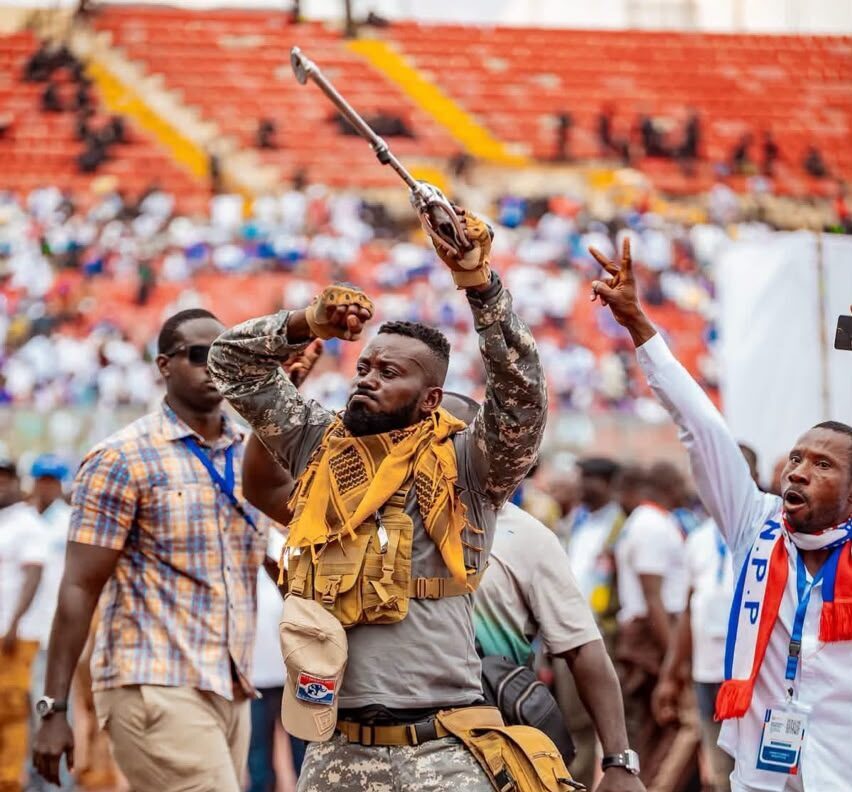
For a man whose political journey began far from the corridors of party leadership, Kojo Fosu Boadu’s rise to the top of the New Patriotic Party’s (NPP) vice-chairmanship race was hardly the outcome many expected.
Popularly known as Kojo Bamba, the Asafo-born auto mechanic and former “bodyguard” emerged from a field of 13 contestants to become the party’s First Vice Chairman, polling 3,116 votes at the NPP’s National Delegates Conference in Kumasi.
He edged the immediate past National Organiser, Henry Nana Boakye, who obtained 3,061 votes, while former Communications Director and former STC Managing Director Nana Akomea secured the third position with 2,987 votes.
Bamba’s victory was particularly striking because the contest featured several candidates with established records in government, party administration and public service.
Among those he defeated were Dr Mustapha Abdul-Hameed, former Chief Executive Officer of the National Petroleum Authority and former Minister of Information and Inner-City and Zongo Development; Samuel Pyne, former Kumasi Metropolitan Chief Executive; former National Treasurer George Kwabena Abankwah Yeboah; former Communications Director Richard Ahiagbah; and Alhaji Masawudu Osman, the immediate past vice chairman.
Yet Bamba’s campaign did not attempt to compete with his opponents on academic or administrative credentials.
Instead, he offered delegates a different proposition.
“To ma Akrakyefoɔ mmienu, na to ma me Kojo Bamba na me mɔ mo ho ban!”
In essence, Bamba was asking delegates to vote for two educated candidates and then give their third vote to him, the “machoman” who, he said, would protect party members and the party.
His pitch was that the party needed those candidates — but it also needed him.
That was the thinking behind his repeated appeal to delegates to select “two educated elites” and then choose him as the candidate who would provide the grassroots presence to protect party members and their votes.
But while the campaign appeared aimed at getting him into the top three, the final results delivered something more.
Kojo Bamba did not merely secure a vice-chairmanship position. He finished first.
The Unconventional Journey to NPP’s National Leadership
Bamba’s story is different from the conventional route to the upper ranks of party politics.
He hails from Asafo, a Kumasi suburb, and worked as an auto mechanic before becoming involved in partisan politics as a “machoman.”
His political profile rose sharply in 2017 when he was identified as a leader of the Delta Forces vigilante group.
On March 23, 2017, members of the group stormed the Ashanti Regional Coordinating Council offices and forcibly removed an appointed Regional Security Liaison Officer from his office. The group was protesting the appointment, which it opposed.
The incident attracted national attention and led to Bamba’s arrest and subsequent court proceedings.
He later largely disappeared from the political spotlight, although he was occasionally seen around the party’s security arrangements.
For a period, Bamba was also known to have served as a bodyguard to Henry Nana Boakye, popularly known as Nana B, who would later become one of his principal opponents in the 2026 vice-chairmanship contest.
That detail adds another layer to the eventual outcome of the election.
Nana B, an experienced party organiser who had just completed his tenure as National Organiser, was contesting the same vice-chairmanship race against Bamba, his former boss-turned-contestant ultimately finishing second with 3,061 votes, just 55 votes behind Bamba.
Nearly a decade later, Bamba had moved from providing personal security within the party’s political circles to competing directly with some of the party’s most experienced figures for a place at the highest level of its national executive.
And he did not merely compete.
He finished ahead of them.
The Underdog the Polls Overlooked
Bamba entered the vice-chairmanship contest alongside 12 other candidates, but he was not initially regarded as one of the leading contenders.
A Global InfoAnalytics survey released ahead of the October 3 election placed him at 17% in the vice-chairmanship race, behind several of the better-known candidates. The polling also showed a highly competitive contest, with several candidates separated by only a few percentage points.
The final results, however, produced a different picture.
When the Electoral Commission announced the results in the early hours of Sunday, October 4, Bamba had topped the field with 3,116 votes.


Henry Nana Boakye followed with 3,061, Nana Akomea had 2,987, while Dr Mustapha Abdul-Hameed finished just outside the top three with 2,956 votes.
The three leading candidates were subsequently elected First, Second and Third Vice Chairmen respectively.
The full results below:
- Kojo Fosu Boadu — 3,116 votes
- Henry Nana Boakye — 3,061 votes
- Nana Akomea — 2,987 votes
- Mustapha Abdul-Hameed — 2,956 votes
- Yaa Amponsah Frimpong — 1,503 votes
- Richard Ahiagbah — 1,001 votes
- Alhaji Masawudu Osman — 890 votes
- George Kwabena Abankwah Yeboah — 247 votes
- Horma Miez — 232 votes
- Samuel Pyne — 206 votes
- Abena Pokua Boaitey Amoah — 194 votes
- Richard Oti Aboagye — 152 votes
- Bright Esselfie Kumi — 51 votes
Beyond the Ballot: Lessons From Kojo Bamba’s Rise
The just-ended NPP National Delegates Conference has produced more than new national executives and a new leadership structure for the party.
It has also offered a number of lessons that extend beyond politics.
One of the clearest is that people should not always allow their present position to determine the limits of their ambition.
Bamba’s journey is a striking example.
A man who started out as an auto mechanic, became involved in grassroots party activities, was associated with the “machoman” tag and at one point served as a bodyguard within the party’s political circles eventually found himself competing for one of the NPP’s highest national executive positions.
And when the opportunity came, he did not campaign as though he had to imitate the established politicians around him.
He identified what he believed he could offer and built his campaign around it.
There is also a lesson in not allowing conventional expectations to define what is possible.
Before the election, Bamba was not widely regarded as the favourite. Polling placed him behind some of the more established names, while his opponents came with ministerial experience, party positions, public-sector leadership and years of political visibility.
Yet the ballot delivered a different verdict.
That does not necessarily mean experience or qualifications do not matter. Rather, the result demonstrated that voters — or, in this case, delegates, can sometimes respond to qualities and messages that conventional analysis does not fully capture.
There is another lesson in his relationship with Nana B.
A person who once served as a bodyguard to Henry Nana Boakye eventually found himself standing on the same ballot paper as his former boss, competing for the same national executive position.
The outcome was even more striking: Bamba finished first, while Nana B finished second.
The story therefore speaks to how positions can change, opportunities can arise and relationships can evolve.
It is also a reminder that the person assisting someone else’s journey today may one day be walking a different path of his own.
Perhaps the broader lesson is that success does not always follow the route people expect.
Bamba did not have to become the most polished candidate in the race. He had to convince enough delegates that his own contribution mattered.
His “Akrakyefoɔ mmienu” message was built around precisely that idea: choose the experienced and educated candidates, but do not overlook me.
The election result suggests that many delegates did not overlook him.
The ‘Machoman’ Who Punched Above His Weight
The significance of Bamba’s election lies not only in the number of votes he obtained, but also in the profile of the candidates he defeated.
Dr Mustapha Abdul-Hameed brought academic and ministerial experience. Nana Akomea had served as the NPP’s Communications Director and later headed STC. Samuel Pyne had served as Kumasi Metropolitan Chief Executive. Richard Ahiagbah had been the party’s Communications Director, while Henry Nana Boakye had just completed his tenure as National Organiser.
Bamba, by contrast, had not previously occupied a national executive position in the NPP.
Yet when delegates were given the opportunity to choose three vice chairpersons from the 13 candidates, his name emerged first.
The result was particularly notable given the pre-election expectations surrounding the race. Professor Smart Sarpong, for instance, said he had expected Bamba to be among the top three but did not anticipate that he would finish first.
For Bamba, the campaign message had therefore produced an outcome that went beyond its apparent objective.
He had asked delegates to give him one of their votes alongside two “Akrakyefoɔ”.
When the votes were counted, he had secured more votes than every one of the 12 candidates.
What Bamba says his victory represents
Following his election and swearing-in, Bamba sought to frame his new position less as a personal achievement and more as a responsibility to the youth.
In a social media post, he wrote:
“I do not see myself as better than anyone else. I see myself as a voice for the youth, a representative of their hopes, dreams and aspirations. My ambition goes beyond personal success; it is about creating opportunities and ensuring that the next generation has a fair chance to rise.
“So many destinies risk remaining in the shadows if we fail to restore power in 2028. Our youth deserve opportunities, our people deserve hope, and our future deserves a renewed commitment to progress.
“The NPP must rise again in 2028, not just for political power, but for the countless dreams and destinies that depend on a brighter future.”
For Bamba, therefore, the journey from an Asafo mechanic and grassroots political operative to First Vice Chairman of the NPP has now entered a new phase.
The campaign that asked delegates to vote for “Akrakyefoɔ mmienu” and then give their other vote to Kojo Bamba became more than a slogan.
It became the defining feature of an unlikely campaign — one that took a candidate who was not widely regarded as the favourite and placed him at the top of the NPP’s vice-chairmanship race.
The story of Bamba’s rise also leaves a lesson beyond the ballot box: sometimes, the person others do not initially see as the obvious choice can become the choice that changes the entire outcome.
The “machoman” did not simply make it into the top three.
He finished first.
By: Obeng Emmanuel P. Darlington