






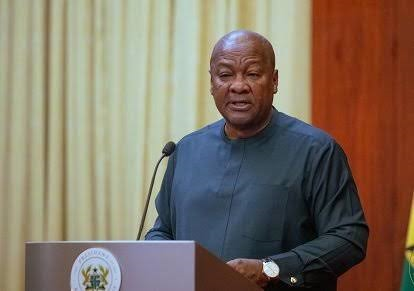
President John Dramani Mahama has defended the introduction of the TraffiTech-GH automated traffic enforcement system, urging motorists unhappy with the fines to comply with speed limits rather than risk penalties.
He maintained that drivers who observe the prescribed limits have no reason to worry about the system, insisting that speeding remains a major contributor to road accidents and must be addressed through stricter enforcement.
“If it is too expensive, then do not speed, and so there is a solution to that. The maximum speed in town is 50km/h. However good the road is, you do the 50km/h. If you do that, you are fine, and you will not have to pay anything,” he said.
The President made the remarks in an interview with 1957 News on the sidelines of the 2026 Commonwealth Heads of Government Meeting (CHOGM) at Jumby Bay Island in Antigua and Barbuda.


His comments come amid growing public criticism of TraffiTech-GH, particularly over the penalties associated with speeding offences. Some motorists have argued that the government should improve road infrastructure, including fixing damaged roads, faulty traffic lights and inadequate road signage, before introducing automated enforcement.
Some driver unions have also threatened industrial action in opposition to the system.
Mahama rejects calls to delay enforcement
Responding to concerns that the technology was being introduced before the country’s road infrastructure had been adequately improved, the President argued that road maintenance and traffic law enforcement should not be treated as mutually exclusive responsibilities.
He maintained that poor road conditions did not give motorists the justification to disregard existing speed regulations, adding that the government could pursue infrastructure improvements while enforcing traffic laws.
Drawing comparisons with the United Kingdom, he noted that speed cameras were used to regulate motorists despite imperfections in its road network.
“My understanding is that Traffitech has begun with overspeeding; they have not yet added the other components of jumping red light, parking wrongly,” he said.
“And so I hear they [the public] say we should fix the roads before we introduce Traffitech. I mean, it doesn’t happen like that. The roads are not perfect in the UK, and yet they have speed cameras,” he added.
TraffiTech-GH was introduced by the Motor Traffic and Transport Department (MTTD) of the Ghana Police Service on November 1, with high-technology cameras initially deployed to identify motorists who exceed prescribed speed limits. Other offences, including running red lights and illegal parking, are expected to be incorporated into the system.
Police directed to install warning signs
Although he defended the initiative, Mr Mahama acknowledged the importance of transparency in its implementation and called on the police and other responsible agencies to install signs alerting motorists to the presence of speed cameras.
He said drivers should receive adequate warning when approaching monitored sections of the road to ensure they understand where the technology is being used.
“All I will urge is that the police and those implementing Traffitech should put signs showing where the cameras are, because that is one of the things you need to do if you are introducing this kind of innovation,” he said.
“You need to put signposts, warning motorists, that there is a speed camera ahead. I think that transparency is important,” he added.
Road safety concerns
The President also pointed to the impact of speeding on vulnerable road users, particularly schoolchildren, as justification for the stricter enforcement measures.
He cited the number of children knocked down by vehicles while returning from school, arguing that stronger measures were needed to prevent fatalities and life-changing injuries.
“If you look at the number of children knocked down every year in Ghana when they are coming from school, you will understand why it is important for us to check over speeding. Children coming from school are knocked down and killed or permanently injured, and so it is important for us to check speeding,” he said.
The government has presented TraffiTech-GH as part of efforts to improve compliance with road traffic regulations and reduce preventable accidents through technology-driven monitoring.
However, the rollout continues to face resistance from sections of the motoring public, with concerns over the cost of penalties and the state of road infrastructure remaining central to the debate.