






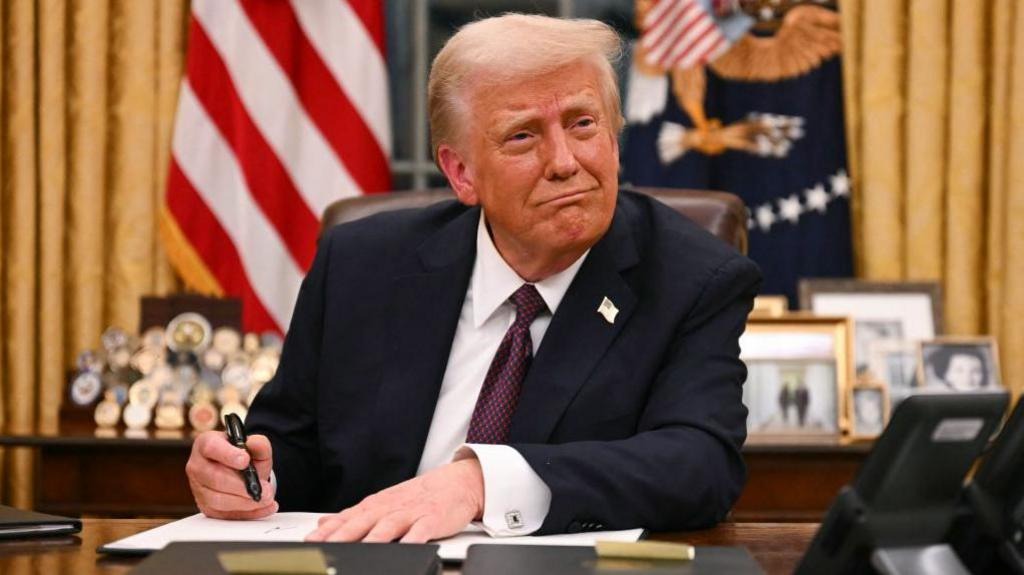
United States paper currency will soon carry the signature of President Donald Trump, marking the first time a sitting president’s name will appear on American banknotes, the Treasury Department announced.
The move, which forms part of activities to commemorate the United States’ 250th anniversary of independence, represents a historic departure from a 165-year tradition in which only treasury officials signed the nation’s currency.
Under the new directive, Trump’s signature will appear alongside that of Treasury Secretary Scott Bessent. At the same time, the long-standing inclusion of the US treasurer’s signature on banknotes will be discontinued.
The first redesigned $100 bills bearing the signatures of Trump and Bessent are expected to be printed in June, with other denominations to follow in the months ahead. Officials say it may take several weeks for the new notes to enter circulation through the banking system.
The Treasury is still producing currency bearing the signatures of former Treasury Secretary Janet Yellen and former Treasurer Lynn Malerba. Malerba will become the last in an unbroken line of treasurers whose signatures have appeared on US currency since 1861, when the federal government first issued paper money.
Explaining the decision, Bessent described the move as a symbolic recognition of both national progress and presidential leadership.
“There is no more powerful way to recognize the historic achievements of our great country and President Donald J Trump than US dollar bills bearing his name,” Bessent said.
He added that issuing the redesigned notes during the country’s semiquincentennial celebration was appropriate, citing strong economic growth and financial stability during Trump’s second term.
Despite the change in signatures, Treasury officials clarified that the overall design of US banknotes will remain largely unchanged, apart from replacing the treasurer’s signature with that of the president. Existing legal requirements—such as the inclusion of “In God We Trust” and the use of portraits of deceased individuals—will still apply.


The signature change is the latest in a series of efforts by the Trump administration and its allies to associate the president’s name with national symbols, institutions, and programmes. Recently, a federal arts panel approved the design of a commemorative 24-karat gold coin featuring Trump’s image as part of the anniversary celebrations.
Supporters of the move have praised it as a reflection of national strength. Former US Treasurer Jovita Carranza described it as “a powerful symbol of American resilience, the enduring strength of free enterprise and the promise of continued greatness.”
Current US Treasurer Brandon Beach also backed the initiative, stating that the nation’s currency will “continue to stand as a symbol of prosperity, strength, and the unshakable spirit of the American people,” while crediting Trump as the architect of a “golden age economic revival.”
However, the decision has drawn criticism from political opponents. California Governor Gavin Newsom took to social media to attack the president’s economic record, stating: “Now Americans will know exactly who to blame as they’re paying more for groceries, gas, rent, and health care.”
Efforts to further expand Trump’s presence on US currency have faced legal hurdles. A proposal for a circulating $1 coin bearing his image has stalled due to laws prohibiting the depiction of living individuals on US coins.
This is not the first time Trump’s name has appeared on official financial instruments. During his first term, his name was printed on economic relief cheques distributed to millions of Americans during the COVID-19 pandemic.