






Andy Burnham has officially become the United Kingdom’s new prime minister after being invited by King Charles III to form a government, succeeding Keir Starmer as leader of the governing Labour Party.
Burnham assumes office after Starmer stepped down just two years into his premiership, following mounting political pressure and declining support within both his party and the wider public. His appointment makes Burnham the seventh British prime minister since 2016, highlighting a decade of political instability in the UK.
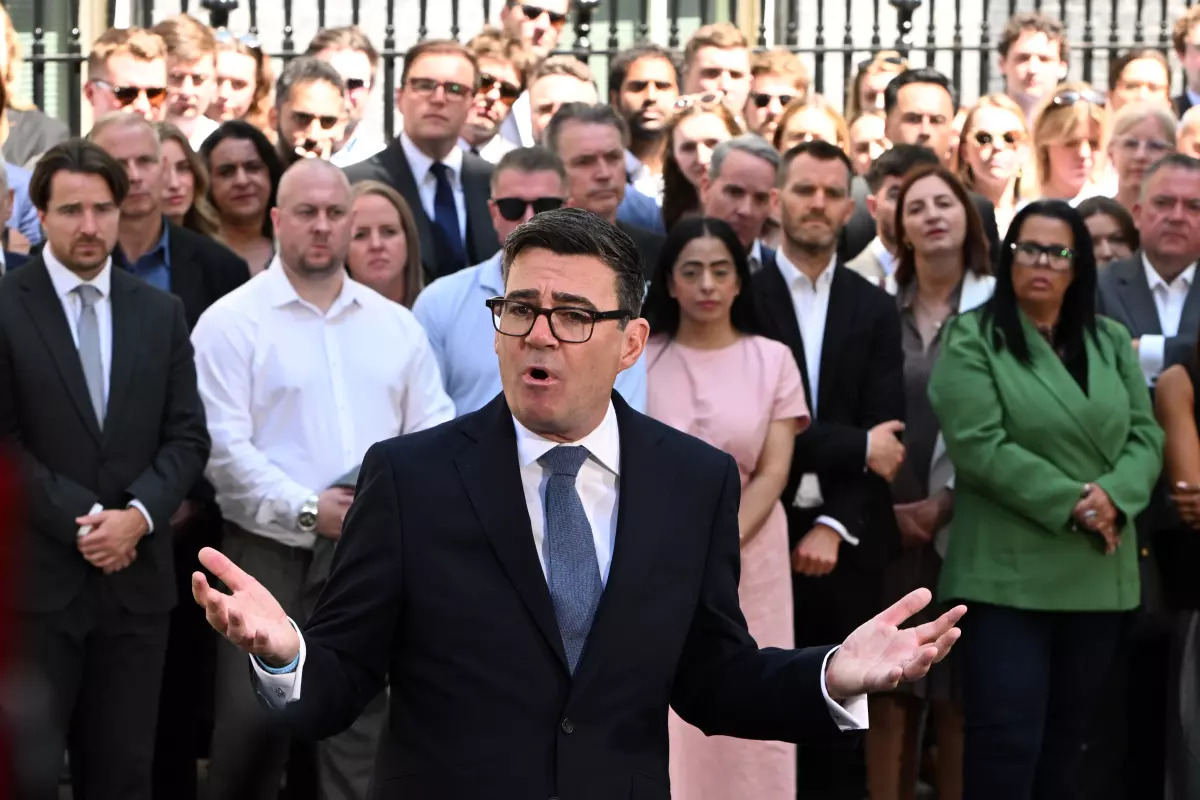
In his first address outside 10 Downing Street on Monday, Burnham pledged to reshape Britain’s political system by shifting power away from Westminster and giving local communities greater control over decision-making. He also promised to tackle homelessness by ending rough sleeping and outlined plans for stronger public oversight of essential services.
“We will change politics to make it more collaborative, more about problem-solving than point-scoring,” Burnham said. “We will take power out of here and carry it into every postcode in the land so that they can do more and in doing more, build a new economy where we put life’s essentials back under stronger public control to make them affordable to you again.”
Reflecting on the challenges ahead, Burnham acknowledged the political instability that has characterised recent British governments.


“This a moment for reflection and new resolution,” he said. “It requires my generation of politicians to raise our game and rise to the new challenge. Britain needs to show the world that we can regain our stability once again, and that is our challenge to make politics work, to make it work better.”
The new prime minister has pledged what he described as a “circuit breaker” for a political and economic system he believes has drifted in the wrong direction since the wave of privatisations introduced during the 1980s. While he outlined broad ambitions for reform, he is expected to provide further details on how his government intends to implement its agenda in the coming weeks.
Burnham secured the Labour leadership unopposed after receiving overwhelming backing from Labour MPs, paving the way for a smooth transfer of power without a general election. Under the UK’s parliamentary system, the governing party can replace its leader during a parliamentary term, meaning the next general election is not required until 2029 unless called earlier.
Outgoing Prime Minister Keir Starmer formally tendered his resignation to King Charles III after delivering a farewell address outside Downing Street, saying he was proud of his government’s achievements and believed Britain had become “stronger and fairer” during his time in office.
Burnham now inherits a series of pressing challenges, including sluggish economic growth, the ongoing cost of living crisis, pressure on public services, migration concerns and complex foreign policy issues such as the wars in Ukraine and the Middle East.
His administration will also face the task of restoring confidence in government while delivering on promises to revive the economy and rebuild trust in Britain’s political institutions.