






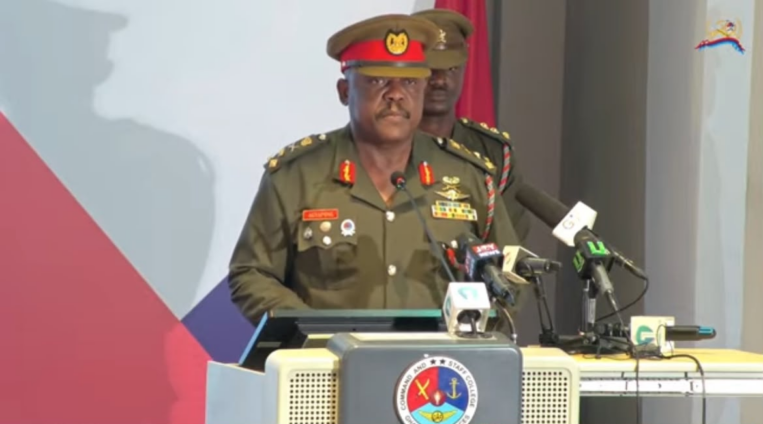
The Chief of Defence Staff (CDS), Lt. Gen. William Agyapong, has cautioned that violent extremist groups operating across the Sahel are steadily expanding their reach towards Ghana, warning that the country’s northern frontier faces an increasingly complex security challenge.
Speaking on behalf of the Deputy Minister for Defence, Ernest Brogya Gyenfi, during the 50th Anniversary Republic Day Public Lecture at the Ghana Armed Forces Command and Staff College in Teshie, Lt. Gen. Agyapong said the security landscape in West Africa has undergone significant changes, requiring Ghana and its regional partners to strengthen their preparedness and cooperation.
According to him, extremist groups in the Sahel have become increasingly sophisticated, adaptable and well-equipped, allowing them to extend their influence beyond their traditional strongholds.
“They have already penetrated the northern belt of our neighbours to the north and are probing further south. Indeed, some of our compatriots have fallen victim,” he stated, referring to recent attacks in the sub-region, including the killing of Ghanaian traders in Titao.
Beyond the northern threat, the CDS warned that Ghana must also contend with rising criminal activity in the Gulf of Guinea. He said piracy, armed robbery at sea and other maritime crimes have become closely linked to wider transnational criminal networks, some of which provide financial and logistical support to extremist groups.
He noted that attacks on Ghanaian fishermen have become a growing concern, with armed criminals frequently stealing outboard motors and abandoning victims at sea. Such incidents, he said, threaten the country’s maritime economy and the livelihoods of coastal communities.
Lt. Gen. Agyapong observed that Ghana now sits between two evolving security fronts—violent extremism advancing from the Sahel in the north and maritime insecurity in the Gulf of Guinea to the south.
“This is not an alarmist observation. It is a planning reality that requires our full attention,” he stressed.
To address these emerging threats, he disclosed that government is investing in the retooling of the Ghana Armed Forces to improve border protection, strengthen maritime surveillance and enhance the military’s operational capabilities.
He also called for stronger collaboration among policymakers, security practitioners and academic institutions, arguing that effective responses to modern security threats require informed strategic thinking and evidence-based policy development.
Addressing officers undergoing training at the Command and Staff College, the CDS urged them to cultivate strategic leadership alongside tactical expertise. He noted that contemporary security threats often exploit governance weaknesses, social grievances and ungoverned spaces rather than relying solely on conventional warfare.


Reflecting on the institution’s 50-year history, Lt. Gen. Agyapong praised the Ghana Armed Forces Command and Staff College for producing senior military leaders for Ghana and other African countries. He, however, urged the institution to continue evolving to anticipate future security challenges instead of merely reacting to them.
Describing the regional security outlook, he said the Sahel should be viewed as “a warning,” while the Gulf of Guinea is “riding the storm,” stressing that the changing security environment demands a coordinated regional response to safeguard peace and stability across West Africa.