






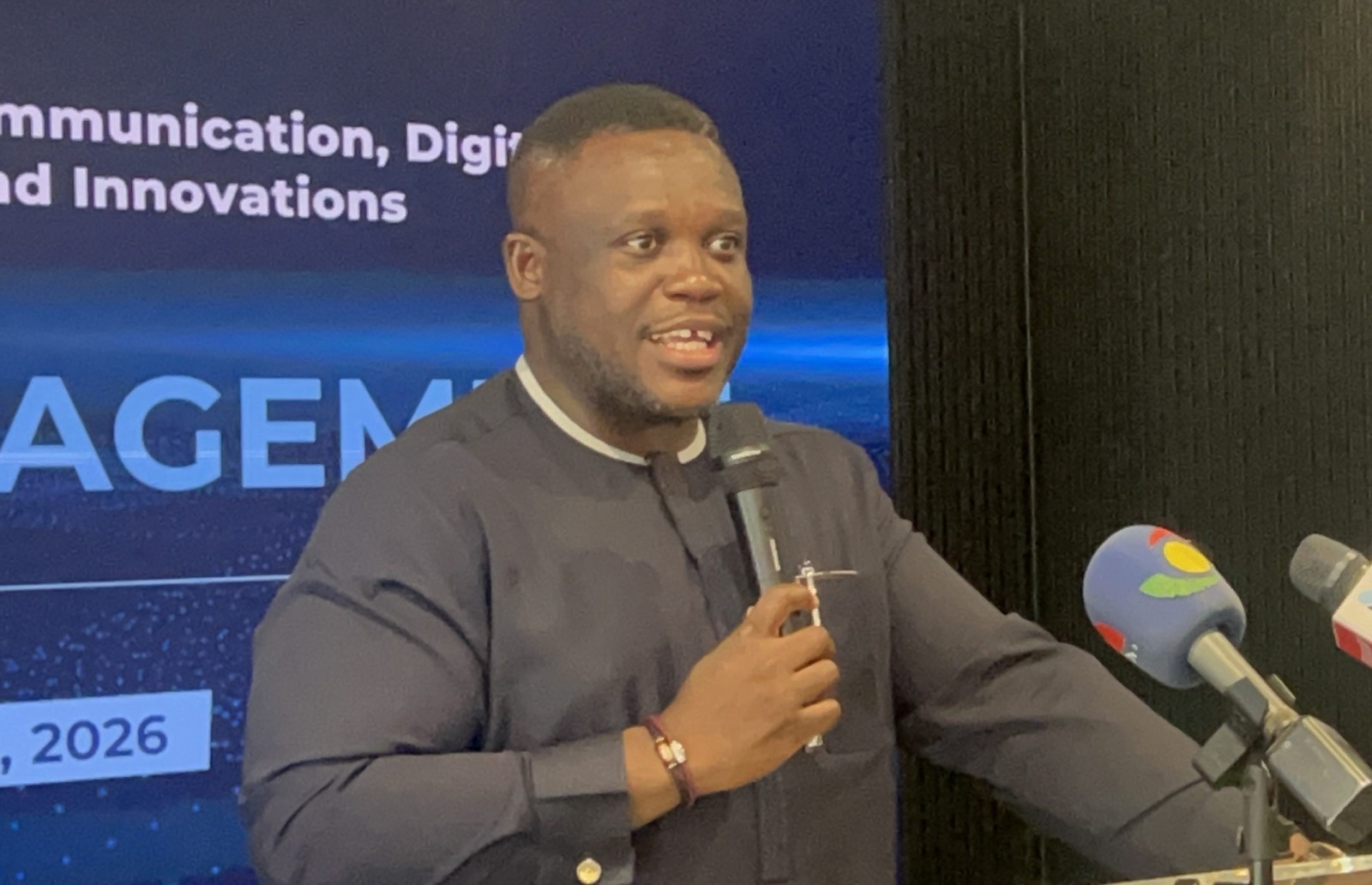
The Minister of Communication, Digital Technology and Innovations, Samuel Nartey George, has assured Ghanaians that the next SIM registration exercise will be the last, citing the introduction of a more advanced and reliable system aimed at eliminating fraud and improving user experience.
Speaking at a media stakeholder engagement in Accra, the minister said the upcoming exercise marks a significant departure from previous efforts, which were widely criticised for inefficiencies, weak verification processes and the inconvenience caused to the public.
He attributed the anticipated success of the new system to strong inter-agency collaboration, noting that key institutions such as the National Identification Authority (NIA) and the National Communications Authority (NCA) are working closely with the ministry, the Ghana Immigration Service and the Ministry of Foreign Affairs.
“The fact that you have multi-agency collaboration on this is something that you didn’t see in previous times. You have the NIA (National Identification Authority) being our single source of truth when it comes to IDs, the NCA (National Communications Authority), the ministry, Immigration Service, Ministry of Foreign Affairs, and other agencies all working together.
“What you see today is the product of very hard and difficult conversations, and that gives me the confidence that if we execute this right, this will be the final SIM registration exercise,” Mr George explained.


He emphasised that public education would play a critical role in the rollout, describing the exercise as largely communication-driven.
“This registration is 75 per cent communication and 25 per cent technology,” he said, adding that lessons from previous exercises—particularly the lack of proper biometric verification—had informed the new approach.
According to the minister, the system will feature enhanced biometric verification, including a “liveliness test” to capture facial data and authenticate users against the NIA database. This, he explained, would help eliminate the use of photocopied or fraudulently acquired Ghana Cards.
Mr George also dismissed calls for automatic migration of existing SIM data into the new system, warning that such a move would only replicate past challenges.
“You are not cleaning up. You are actually migrating the viruses.
You have infected files, and you are migrating them onto a new system.
You are basically replicating the problems of the old system.
And that’s part of the reason why we can’t do a wholesale migration. And that’s cured today by NIA’s solution that they are offering to us based on the collaboration we are having with them,” he said.
To improve accessibility, the minister announced that users would be able to complete the registration process самостоятельно using smartphones, reducing the need to visit service centres. An appointment system will also be introduced for those who require in-person assistance, while mobile registration teams will be deployed nationwide.
Additionally, facilities such as Ghana Post offices and Community Information Centres will be used to extend the exercise to underserved and rural communities.
Mr George indicated that the rollout would commence only after the necessary legal framework has been finalised and approved by Parliament. He assured that stakeholder consultations would continue to ensure a smooth and widely accepted implementation.
He further warned that individuals found repeatedly linking their Ghana Cards to fraudulent SIM registrations risk being blocked from accessing telecommunications services.
Also speaking at the engagement, the Director-General of the National Communications Authority, Edmund Yirenkyi Fianko, said the initiative is designed to establish a credible and secure national SIM register.
He added that the system would be supported by a Central Equipment Identity Register (CEIR), which will allow authorities to block stolen or unauthorised mobile devices across all networks, further strengthening the integrity of Ghana’s telecommunications space.