






President John Dramani Mahama has acknowledged that while flooding remains an unavoidable natural phenomenon, Ghana can significantly reduce its devastating impact through improved planning, stronger mitigation measures and responsible urban development.
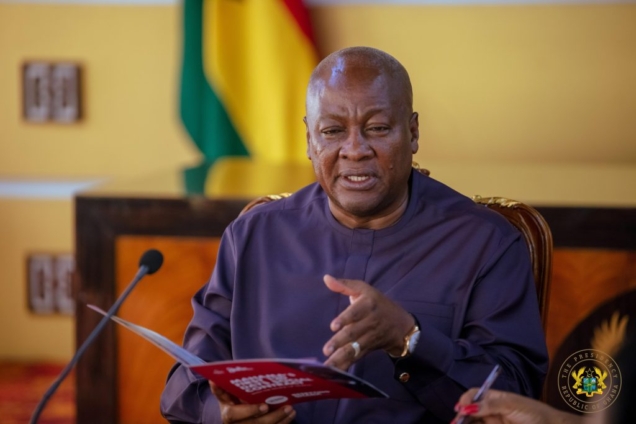
Speaking during a National Security Council meeting on Wednesday, July 8, to assess the recent floods that affected seven regions, President Mahama said government is determined to strengthen the country’s flood preparedness and response.
The meeting brought together members of the National Security Council, the Head of the Post-Flood Mitigation Taskforce, Brigadier General Okae-Yeboah, and leaders of the various subcommittees, who briefed the President on the impact of the disaster and ongoing recovery efforts.
Explaining the purpose of the meeting, President Mahama said, “In the aftermath of the floods that affected a lot of the southern coastal part of our country, I deemed it necessary for us to have a national security meeting to discuss the issues arising out of that natural disaster.”
The President stressed that although floods cannot be completely prevented, their consequences can be greatly reduced.
“We might not be able to completely eliminate flooding because it’s a natural disaster that happens not only in our part of the world, it happens in other areas. But we can minimize it and make its effect less disastrous like what happened.”
He noted that several countries along the West African coast, from Gabon to Côte d’Ivoire, also experienced severe flooding and loss of life, adding that Ghana must continue working to ease the suffering of affected communities.
President Mahama described the latest floods as among the worst the country has experienced, attributing the growing severity to climate change and increasingly intense rainfall.
“It has become a recurring incident, but of course this was far worse than any that we have seen, because of the vagaries of climate change. It looks like increasingly every year the rainfall is getting heavier and it means that we have to see what mitigation measures to put in place.”
He also pointed to rapid urbanisation and the encroachment on waterways and flood-prone areas as major factors worsening the country’s flood situation, particularly in Accra.


“And so aside from that too, the pressures of urbanization, Accra being the capital, it is expanding at a very alarming rate. And the desire for land to build is increasingly making people encroach into areas that were formerly reserved for the passage of water and the containment of water,” he said.
President Mahama disclosed that although a flood mitigation taskforce had been established before the disaster and undertook limited dredging of waterways, the unprecedented volume of rainfall overwhelmed existing drainage systems.
“Of course we set up a task force before the incident occurred. They did some limited work in terms of dredging some of the waterways, but I mean the amount of rainfall that fell this time, it was very difficult to contain.”
He announced that the Minister of Finance has released funding from the Contingency Fund to support ongoing and future flood mitigation efforts.
“Happily, the Minister of Finance has released some money from the contingency fund for us to be able to finance the mitigation measures going forward,” the President added.
The National Security Council meeting forms part of government’s efforts to strengthen disaster preparedness, improve drainage infrastructure and implement long-term measures aimed at reducing the impact of future flooding across the country.