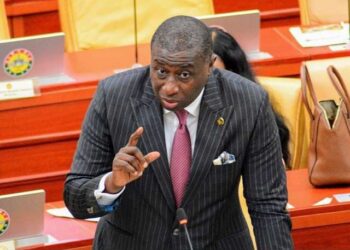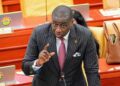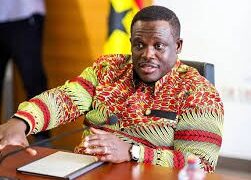







The Minister for Communication, Digital Technology and Innovation, Sam Nartey George, has reaffirmed that the controversial Human Sexual Rights and Family Values Bill remains a priority, despite ongoing debate over the country’s pressing needs.
Speaking to journalists in Accra on Friday, April 10, the Ningo-Prampram MP defended the relevance of the proposed legislation, arguing that critics who call for its deprioritisation fail to recognise the seriousness of issues affecting society.
His comments come in the wake of remarks by President John Dramani Mahama, who, during a meeting with civil society organisations at the Jubilee House on March 30, suggested that while the bill is important, it is not among the nation’s most urgent concerns.
“I explained during my recent engagement with the World Affairs Council that it is not the most important issue we face as a nation. We are still grappling with the provisions of basic needs of education, health care, jobs, food, clothing, and shelter,” the President said.
The statement has sparked widespread discussion, with some religious groups and sections of the public accusing the government of sending mixed signals on the bill’s urgency.
Responding to the backlash, Mr George maintained that the legislation addresses critical concerns around family values and child protection, citing a recent case he described as evidence of the need for action.
“People don’t understand what this is about. Just last week, I had to help a father whose 21-year-old son had been abducted by someone who was sodomising him as his gay lover.”
“A 55-year-old Ghanaian, UK Ghanaian, kept the man’s 21-year-old son away from him. Thanks to COP Lydia Donkor, Director General of CID, who worked with our team to identify, track the number, and identify the person, and rescue the boy just last week,” he said.
He further argued that addressing the bill does not mean neglecting other sectors of national development.
“To those who say we have other priorities, this is a priority for us. This is a priority for us. Any country worth its salt can deal with multiple priorities at the same time,” he stated.
“We’re not saying we should stop building roads because we don’t have enough hospital beds. We’re not saying we should stop building schools because we don’t have enough pipe-borne water flowing through our taps.”
“We are dealing with our roads, we are dealing with our hospitals, we are dealing with our schools, we are dealing with water, we will also deal with our family values.”


Mr George also linked his stance to his electoral mandate, insisting that his constituents strongly support the bill.
“As for me, as the Member of Parliament for Ningo-Prampram, the people voted for me, and that was one of the reasons why they increased my vote margin from sixty-nine percent to seventy-four percent. They said, ‘Sam, go back to Parliament and make sure this bill is passed.’”
“So for my people in Ningo-Prampram and me, this is a priority, along with our roads, which are getting fixed, along with our health clinics, which we are building, along with our school blocks that we are building, and the water problem that we are tackling. So it remains a priority for us.”
The renewed defence of the bill is expected to further fuel national debate, as stakeholders continue to weigh its significance against Ghana’s broader socio-economic challenges.