






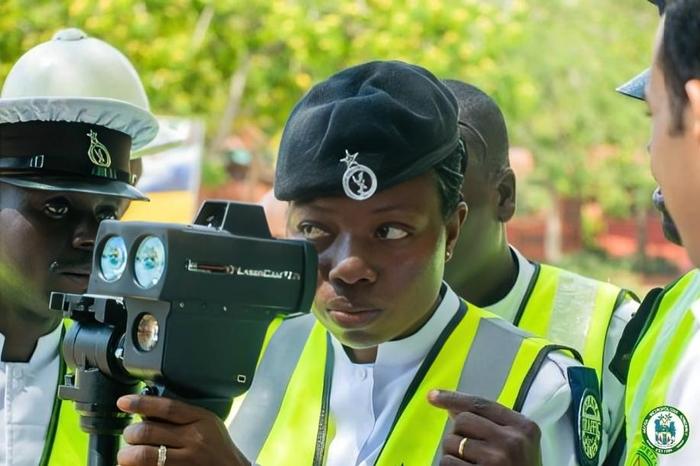
The Ghana Police Service has recorded thousands of speeding offences on the first day of deploying its automated Traffitech-GH system, with some motorists detected driving above 130km/h on roads with a maximum speed limit of 50km/h.
The offences were recorded on Sunday, November 1, when the Police Motor Traffic and Transport Department (MTTD) began using the digital monitoring system to detect and document traffic violations across selected roads.
Director of Education, Research and Training at the MTTD, Assistant Commissioner of Police (ACP) Alexander Kwaku Obeng, disclosed this in an interview on Joy FM on Monday, November 2.
He said the initial exercise was intended to assess motorists’ driving behaviour, particularly on open roads where relatively lighter traffic and limited police presence could encourage speeding.
Although several drivers were found to be complying with the prescribed speed limits, ACP Obeng said the monitoring exercise uncovered widespread violations, including cases of extreme speeding.
He identified Mahama Road, from Boundary Road, as one of the locations where motorists were captured travelling at speeds exceeding 130km/h despite the 50km/h limit.
Other locations where speeding offences were detected included the Boteyman stretch, from School Junction towards the motorway, the Mallam-SCC-Kokrobite Junction road, and the road from the police station at the toll booth towards Kasoa.
The stretch from the toll booth through Amanfrom and over the Kasoa flyover was also identified as another area where motorists were monitored.
According to ACP Obeng, the decision to begin the exercise over the weekend was deliberate, as the Police wanted to establish how drivers behaved on relatively open roads when traffic was lighter.
“We leveraged that to observe and see whether it is the same, and there were many compliant drivers who were driving within the speed limits,” he said.
However, he expressed concern about the number of motorists who exceeded the prescribed limits, particularly on roads within the city.
“Some were doing above 130km/h on Mahama Road from Boundary Road,” he disclosed.
ACP Obeng said the Police had accumulated digital evidence against thousands of motorists within the first 24 hours of the system’s activation, although he declined to disclose the precise number of offences recorded.
“But yesterday [Sunday], we were worried because it was in the thousands,” he said.
He urged motorists to observe speed limits, cautioning that roads with straight and flat stretches within residential and urban areas should not be mistaken for highways or motorways.
He specifically highlighted the Boteyman stretch as a road where the Police had recorded several fatal crashes.
“Please, we are picking up a lot of fatal crashes there. So, when the road is straight and flat in the city, don’t think it is a highway or motorway,” he cautioned.
ACP Obeng further explained that motorists captured by the system would receive digital traffic tickets containing details of their alleged offences and supporting evidence.
The tickets, powered by GPS MTTD technology, would contain the vehicle’s registration number, the registered owner’s name or relevant insurance details, as well as the date, time and location of the offence.
They would also indicate the applicable provision under Regulation 211 of the Road Traffic Regulations, the relevant penalty units, the total fine and a two-week payment deadline.
Motorists issued with tickets would have the option of paying the prescribed fine or contesting the alleged offence.


ACP Obeng said vehicle owners could follow the payment instructions through the link provided on their tickets or access the service using the USSD code 7100#.
Before making a payment or challenging a ticket, however, motorists would be able to review a six-second video clip and photographs showing the alleged traffic violation.
He said the evidence would allow vehicle owners to establish the circumstances surrounding the offence before deciding on their next course of action.
The MTTD director said the system was intended to strengthen traffic law enforcement by enabling the Police to detect and document violations even on roads where officers were not physically stationed.
Traffitech-GH is an automated traffic enforcement system developed by the Ghana Police Service to improve road safety and enforce traffic regulations. It uses cameras and sensors to capture photographs and videos of vehicles involved in violations, including speeding and running red lights.