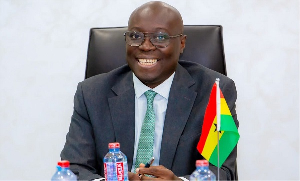







Finance Minister, Dr. Cassiel Ato Forson, has stated that the government is in no hurry to return to the international capital market to raise funds following the conclusion of the country’s three-year programme with the International Monetary Fund.
Speaking at a press conference in Accra on Friday, May 15, Dr Forson stressed a cautious approach to external borrowing as Ghana exits the IMF-supported programme.
“Government is not in a hurry to return to the international capital market.”
His comments come at a time when questions are being raised about Ghana’s post-IMF financing strategy and how quickly the country may seek to re-enter the Eurobond market after years of debt restructuring and fiscal adjustments.


Also addressing the issue, IMF Staff Team Lead for Ghana, Dr Ruben Atoyan, noted that the decision on whether to access international capital markets rests solely with the country.
“In terms of the access to the capital market, it is a sovereign decision for Ghana.”
His remarks underscored the IMF’s position that while it provides policy guidance and programme support, borrowing decisions remain within the sovereign authority of member states.
The statements followed the government’s announcement on Friday, May 15, marking the successful conclusion of Ghana’s Extended Credit Facility (ECF) programme with the IMF. The announcement was made in a statement issued by the Minister for Government Communications, Felix Kwakye Ofosu Felix Kwakye Ofosu.
According to the statement, the exit represents a major economic milestone, reflecting improved macroeconomic stability and debt sustainability achieved ahead of schedule.
It further highlighted gains in Ghana’s credit profile, noting that “Ghana’s sovereign credit ratings have improved significantly from restricted default (Junk Status) to ‘B’ with a positive outlook, representing five distinct rating levels upgrades. This reflects improved fiscal performance, normalised creditor relations, stronger external buffers, and renewed market confidence.”
The government also pointed to a significant build-up in external buffers, stating that “Ghana’s gross international reserves have risen to an all-time high, reaching approximately US$14.5 billion by February 2026, almost 6-months of import cover.”
“These foreign exchange reserve buffers provide Ghana with the capacity to withstand external shocks and stand on its own feet,” the statement added.
While declaring the end of what it described as a bailout phase, the government expressed gratitude to citizens and stakeholders for their role in the reform process.
“Government is exceedingly grateful to the people of Ghana for their sacrifices, resilience and forbearance. The Government also expresses deep gratitude to its bilateral creditors, the Official Creditor Committee (OCC) and external and domestic investors for their collective sacrifice. Going forward, Ghana will engage with the IMF Policy Coordination Instrument (PCI).”
The new engagement framework, the Policy Coordination Instrument (PCI), is described as a non-financing arrangement focused on technical support, reform monitoring, and investor confidence-building.
“The PCI is a form of Technical Assistance engagement with the IMF. It is a non-financing instrument designed to help countries implement economic reforms, signal commitment to policies, and unlock financing from private investors and other development partners. For the avoidance of doubt, the PCI does not provide financial bailout, but will offer continuous capacity development, confidence boost to the market, and deliver a catalytic effect for fresh financing to Ghana.”
According to the statement, the PCI is expected to complement government efforts to achieve an investment-grade credit rating, lower borrowing costs, and attract long-term capital inflows into key sectors of the economy.
It added that the broader objective is to support sustainable development, job creation, and improved living standards as Ghana transitions beyond IMF financial assistance.