






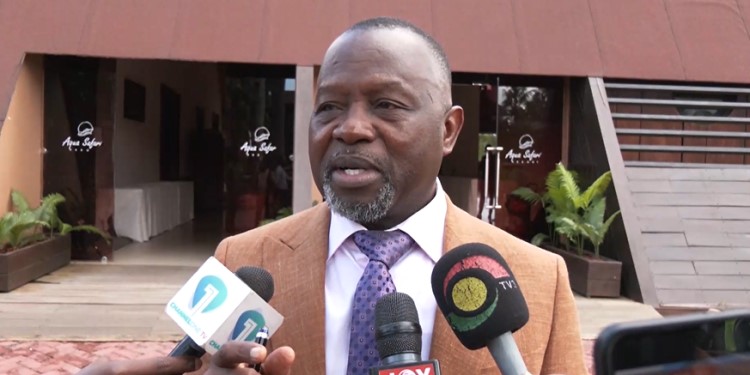
Attorney-General and Minister for Justice, Dr Dominic Ayine, has dismissed claims by the Minority caucus that the Mahama administration is undermining free expression, insisting that allegations of censorship are being exaggerated and taken out of constitutional context.
His comments come amid rising political tension following concerns raised by the opposition New Patriotic Party (NPP), which recently petitioned the diplomatic corps over what it describes as a worsening environment for free speech, judicial independence, and political tolerance in Ghana.
Speaking to journalists on the sidelines of his appearance before the Public Accounts Committee (PAC), Dr Ayine rejected the framing of the situation as a crackdown on civil liberties.
“They are exaggerating a lot with respect to the gagging of free speech,” he said, pointing critics to Chapter Five of the 1992 Constitution, particularly Article 21, which guarantees fundamental human rights while also allowing for lawful restrictions under specific conditions.
According to him, constitutional free expression is not absolute and must be balanced against public safety, public order, morality, and national security considerations.
“If someone is inciting hatred in our society, we do not expect that the Minority will say we should sit down idle as a government and allow that person to go on,” he stated.
To reinforce his argument, Dr Ayine referenced the 1994 Rwandan genocide, arguing that unchecked inflammatory speech and media activity played a key role in escalating violence.
“It was the use of the media that incited the genocide that eventually took place in Rwanda,” he said. “Those are some of the things that led to wars in countries such as Rwanda.”
Despite his strong stance on regulating incitement, the Attorney-General stressed that the government remains committed to protecting legitimate free expression. He described President John Dramani Mahama as a firm believer in democratic freedoms, noting his background in communications as a foundation for his appreciation of free speech.
“He understands the importance of free speech in a democratic society,” Dr Ayine said, adding: “I would be the last person to want to undermine the rights of citizens to freely express themselves.”
He, however, declined to comment on a specific case currently before the courts, citing the sub judice rule, but reaffirmed the government’s broader commitment to civil liberties.


The controversy comes against the backdrop of heightened political friction between the government and the opposition. NPP National Youth Organiser Salam Mustapha, speaking during a courtesy visit to the Dean of the Diplomatic Corps on Tuesday, 19 May, warned that the NPP could resort to unspecified “drastic action” if alleged harassment of party members continues.
His remarks followed the remand of Bono Regional NPP Chairman Kwame Baffoe (Abronye DC) on 13 May 2026. He faces charges of offensive conduct likely to breach the peace and publication of false statements against a judge — allegations the NPP has described as politically motivated.