






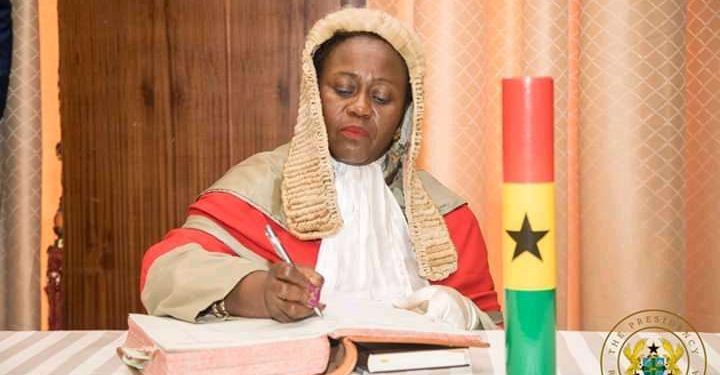
The ECOWAS Community Court of Justice has dismissed an application filed by former Chief Justice Gertrude Araba Esaaba Torkonoo challenging her suspension and subsequent removal from office, ruling in favour of the Republic of Ghana on all issues raised in the case.
In its judgment, the regional court found that Ghana did not violate the former Chief Justice’s rights during the constitutional processes that led to her dismissal. The Court determined all seven issues presented for consideration in favour of the respondent state.
The application sought to challenge the legality of the proceedings that culminated in her removal, including allegations of unfair hearing, bias, violation of her right to work, infringement of her dignity, and denial of access to information.


On the issue of fair hearing, the Court held that the applicant’s right to be heard arose when the matter was referred to the five-member committee established under Ghana’s constitutional process. It explained that the prima facie stage merely serves as a preliminary screening mechanism and does not constitute the actual hearing.
The Court observed that Torkonoo had acknowledged receiving the petitions against her and had been afforded the opportunity to present her case before the committee, concluding that the state had fulfilled its obligations regarding fair hearing.
Addressing allegations of bias and improper constitution of the committee, the Court ruled that the former Chief Justice failed to establish that the involvement of Justices Gabriel Pwamang and Samuel Asiedu in previous matters involving the same petitioners amounted to bias.
According to the Court, participation by judges in earlier cases involving certain parties does not automatically compromise their impartiality. It further stated that matters relating to the composition and procedures of judicial or quasi-judicial bodies fall within Ghana’s domestic legal jurisdiction.
The Court also declined to review the evidentiary findings of the committee that investigated the petitions against the former Chief Justice, stating that such matters were beyond the scope of the proceedings before it.
On claims that her removal violated her right to work, the Court held that the suspension and dismissal followed the procedures outlined under Article 146 of Ghana’s 1992 Constitution.
It noted that the measures taken against the former Chief Justice could not be considered arbitrary or punitive, adding that the constitutional process provided a lawful basis for the actions taken by the state.
The Court further rejected allegations that Torkonoo was subjected to degrading treatment during the proceedings.
She had alleged that her husband was prevented from attending hearings, that participants were subjected to security searches, that the hearing venue was deliberately selected because of its alleged connection to the death of her uncle, and that details of the petitions had been leaked to the media.
However, the Court found that the security arrangements were reasonable considering the sensitivity of the proceedings. It also stated that no evidence had been presented to establish a connection between the venue and the alleged family tragedy.
Regarding media publicity surrounding the proceedings, the Court noted that matters involving the country’s highest judicial officer naturally attract considerable public attention.
The Court also dismissed claims that Ghana violated the principle of lis pendens by continuing the removal process while an application for provisional measures was pending before the ECOWAS Court.
According to the judgment, the filing of an application for interim measures does not legally prevent a member state from continuing domestic proceedings unless a binding order has been issued by the Court.
On the issue of access to information, the Court acknowledged that the right to information is protected under regional human rights instruments but held that the state acted within lawful limitations in declining to provide certain reports and documents requested by the applicant.
The judgment brings to a close Torkonoo’s challenge before the regional court and represents a significant legal victory for the Government of Ghana in the high-profile case surrounding the removal of the country’s former Chief Justice.