








The Peasant Farmers Association of Ghana (PFAG) has called for increased investment in affordable and accessible agricultural innovations to address the challenges facing smallholder farmers and strengthen the country’s food security.
The Association made the call on Friday, October 16, 2026, as Ghana joined the global community to commemorate World Food Day under the theme, “Innovate Today, Nourish Tomorrow.”
In a press release, PFAG said agricultural innovation must respond directly to the realities of smallholder farmers, including climate change, limited access to mechanisation, post-harvest losses and inadequate market access.


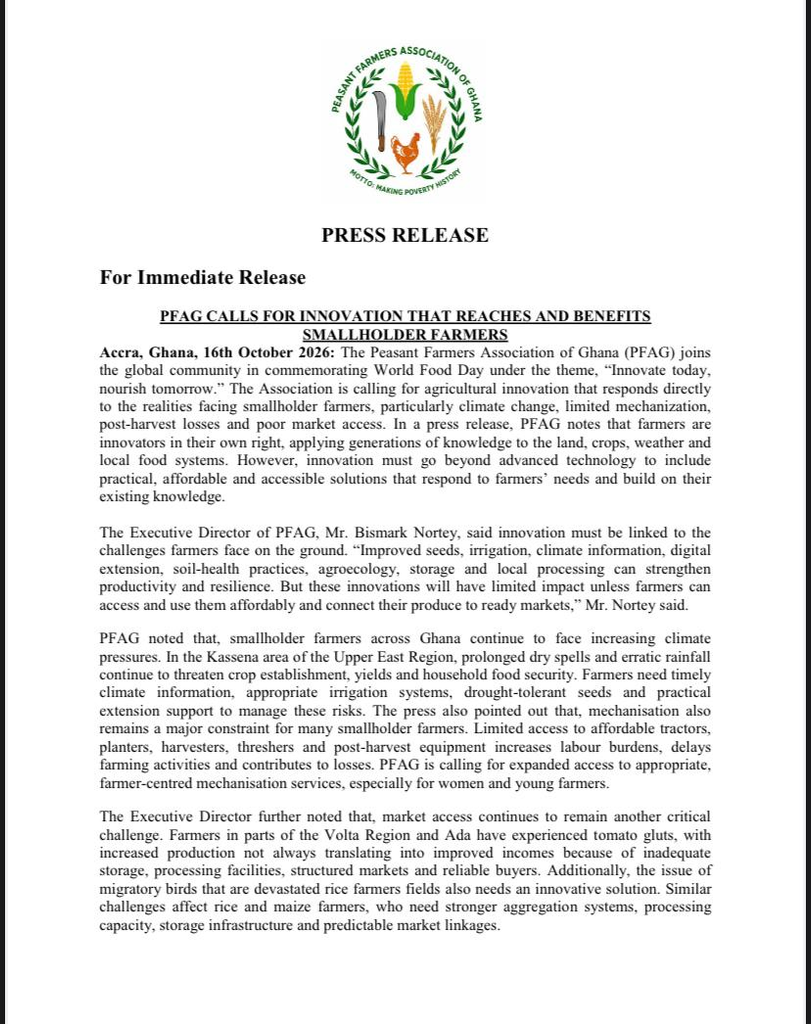
The Association stressed that innovation should go beyond advanced technology to include practical and affordable solutions that build on farmers’ existing knowledge and meet their needs.
PFAG Executive Director, Bismark Nortey, said improved seeds, irrigation, climate information, digital extension services, soil-health practices, agroecology, storage and local processing could improve productivity and strengthen farmers’ resilience.
However, he noted that such interventions would have limited impact if farmers could not access and use them affordably or find reliable markets for their produce.
Climate Change and Mechanisation Challenges
PFAG highlighted the growing climate pressures on smallholder farmers, citing prolonged dry spells and erratic rainfall in the Kassena area of the Upper East Region as threats to crop establishment, yields and household food security.
It said farmers needed timely climate information, appropriate irrigation systems, drought-tolerant seeds and practical extension support to manage the effects of changing weather patterns.
The Association also identified limited access to affordable agricultural machinery as a major constraint, noting that shortages of tractors, planters, harvesters, threshers and post-harvest equipment increase labour demands, delay farming activities and contribute to losses.
It called for expanded access to appropriate mechanisation services, particularly for women and young farmers.
Tomato Gluts and Market Access
The Association further raised concerns about inadequate market access, pointing to tomato gluts experienced by farmers in parts of the Volta Region and Ada.
According to PFAG, increased production does not always translate into better incomes because of inadequate storage and processing facilities, limited structured markets and a lack of reliable buyers.
It also identified migratory birds destroying rice farms as a challenge requiring innovative solutions.
Rice and maize farmers face similar difficulties, the Association said, calling for stronger produce aggregation systems, improved processing capacity, adequate storage infrastructure and more predictable market arrangements.
PFAG Outlines Proposed Interventions
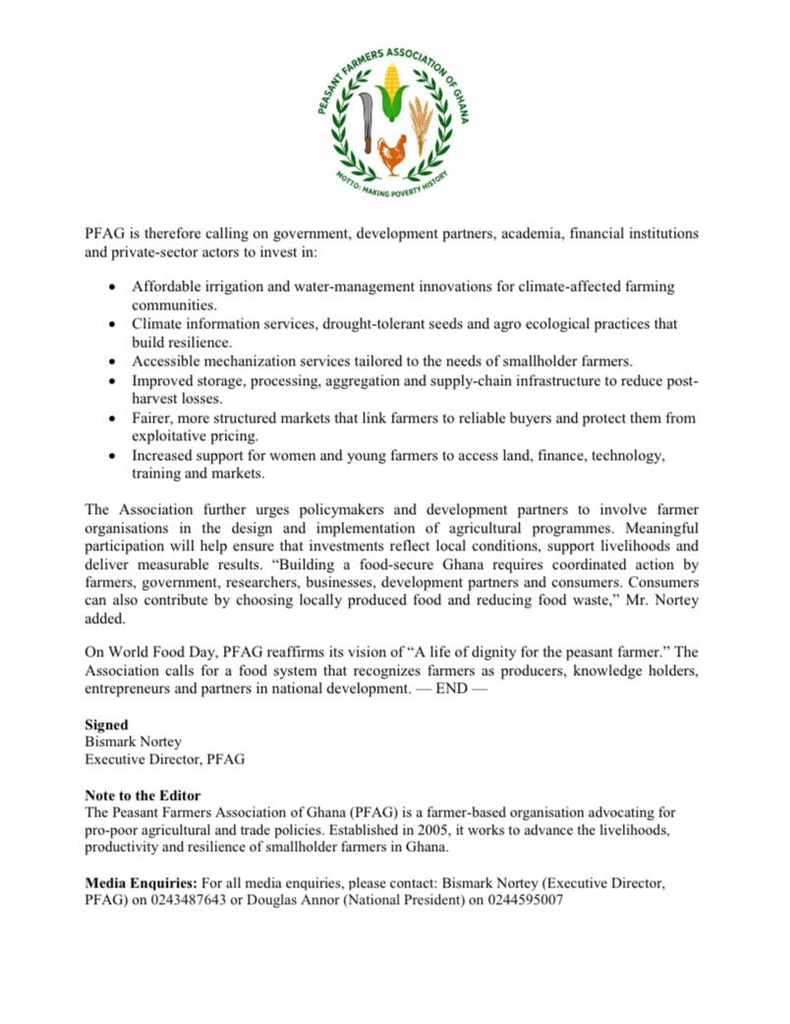
To address these challenges, PFAG urged the government, development partners, academic institutions, financial institutions and private-sector actors to invest in affordable irrigation and water-management systems, climate information services, drought-tolerant seeds and agroecological practices.
It also called for accessible mechanisation services, improved storage and processing infrastructure, and fairer markets that connect farmers to reliable buyers and protect them from exploitative pricing.
The Association urged stakeholders to increase support for women and young farmers by improving their access to land, finance, technology, training and markets.
PFAG further called on policymakers and development partners to involve farmer organisations in designing and implementing agricultural programmes to ensure that interventions reflect local conditions, support livelihoods and deliver measurable results.
Mr Nortey said building a food-secure Ghana required coordinated action from farmers, government, researchers, businesses, development partners and consumers.
He added that consumers could contribute by choosing locally produced food and reducing food waste.
PFAG reaffirmed its commitment to promoting dignity for peasant farmers, emphasising the need for a food system that recognises them not only as producers but also as holders of agricultural knowledge, entrepreneurs and partners in national development.