






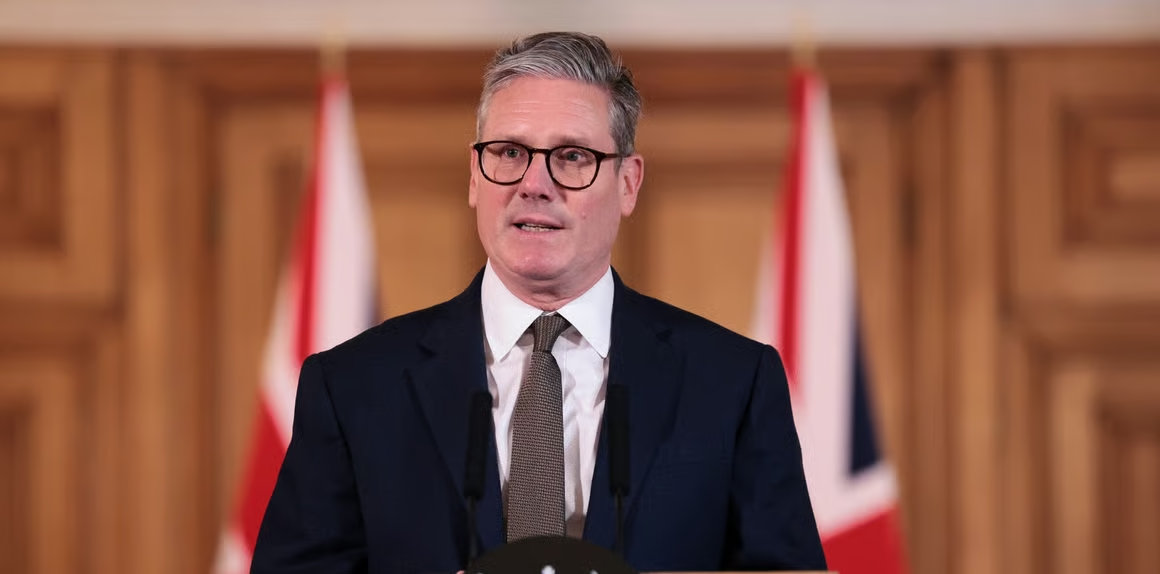
Britain has announced plans to ban children under the age of 16 from accessing social media platforms, in what Prime Minister Keir Starmer has described as a necessary step to protect young people from the growing risks associated with online content.
Speaking on Monday, Starmer said his government would introduce legislation in Parliament before Christmas, with the restrictions expected to take effect in early 2027.
The proposed measures will prevent children under 16 from accessing major social media platforms including TikTok, Instagram, Facebook, Snapchat, YouTube and X. Messaging services such as WhatsApp and Signal will not be affected by the restrictions.
The government also intends to extend safeguards to online gaming platforms and livestreaming services. Additional measures under consideration include preventing minors from communicating with strangers online and introducing overnight restrictions and limits on endless content feeds for users under 18.
“I am not prepared to compromise on the safety and happiness of our children, and that is why this ban must happen,” Starmer said during a news conference.
The announcement follows growing public concern over the impact of social media on children’s mental health, wellbeing and safety. According to the government, a recent public consultation attracted more than 116,000 responses from parents, young people, industry groups and experts.


Officials said 90 percent of parents who participated supported setting the minimum age for social media access at 16, while 85 percent believed the risks associated with social media outweigh its benefits.
Defending the decision, Starmer admitted that no law could completely prevent determined teenagers from finding ways around restrictions. However, he argued that potential loopholes should not stop the government from acting.
“They get around other laws, too, but we don’t say, ‘Oh, look, a teenager managed to get a drink somehow, so let’s not bother banning alcohol sales to children,’” he said. “We don’t do that, that would be utterly ridiculous, and so I just don’t accept that argument.”
The UK’s proposed framework mirrors legislation introduced in Australia last year, which also set out to restrict social media access for children under 16. However, critics argue that such measures may be difficult to enforce and could fail to address the root causes of online harm.
Among those raising concerns is online safety campaigner Ian Russell, whose daughter Molly Russell died in 2017 after being exposed to harmful online content related to suicide and self-harm. Russell criticised the proposal, describing it as a “politically expedient blanket ban” and argued that social media companies should instead be compelled to remove harmful material from their platforms.
The technology industry has also pushed back against the proposed restrictions. The Computer and Communications Industry Association warned that blanket bans could limit young people’s access to positive online experiences and drive them towards less regulated platforms.
“Blanket restrictions will stifle access to age-appropriate experiences with proper parental controls, encouraging children to seek out riskier unregulated alternatives,” said Matthew Sinclair, a senior director of the association in Britain.
Despite the criticism, the plans have been welcomed by many parents and child safety advocates. Justine Roberts, founder of the parenting platform Mumsnet, described the move as “a huge moment for children’s online safety, and for every parent who has felt powerless in the face of addictive technology designed to keep children scrolling.”
The charity Smartphone Free Childhood also praised the decision, calling it a major turning point in efforts to reduce the influence of social media on young people.
“For years, parents have been fighting a losing battle against some of the most powerful companies in the world as smartphones and social media have become an ever bigger part of childhood,” said Joe Ryrie, one of the charity’s founders. “Today feels like a turning point.”
While experts remain divided over how effective the ban will be, the announcement marks one of the most significant attempts yet by a major Western government to limit children’s access to social media and reshape the digital environment in which young people grow up.