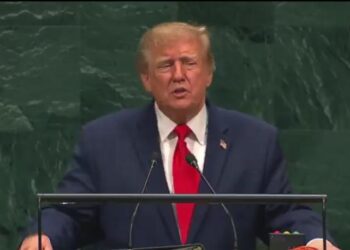







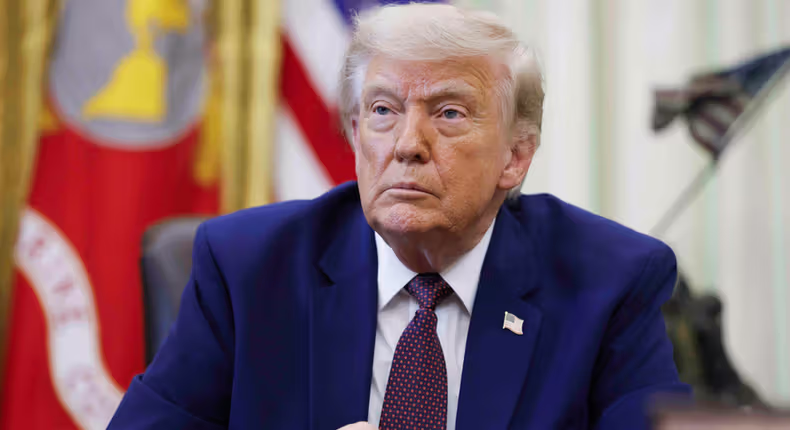
US President Donald Trump has announced plans to immediately bar CNN, Politico and MS NOW from the White House, escalating his long-running dispute with sections of the American media.
Trump made the announcement in a post on Truth Social on Friday, accusing the three outlets of repeatedly publishing or reporting what he described as “fiction or lies” about his administration.
He did not identify specific reports that prompted the decision or explain precisely what form the ban would take.
Trump later described it as a “very simple ban” and suggested that other media organisations could also be affected.
However, reporters from CNN and Politico remained on the White House grounds shortly after the announcement, while a CNN crew was travelling with Vice-President JD Vance to an event in Iowa.
CNN strongly criticised the proposed move, arguing that any attempt to prevent its journalists from covering the White House would violate constitutional protections for the press.
“We have a right under the US Constitution to do that reporting without hindrance or interference from the government,” the network said.
“Should the ban which President Trump threatened go ahead, it would be an illegal assault on that fundamental and constitutionally-protected right.”
Politico also said it would continue covering the administration and indicated it was prepared to challenge any attempt to restrict its access.
“We will vigorously defend our First Amendment rights against any attempt to restrict them,” the organisation said.
MS NOW, formerly known as MSNBC, declined to comment.
Asked about the possibility of additional outlets being targeted, Trump named The New York Times and The Washington Post, describing them as “fake news”.
Later, while answering questions in the Oval Office, Trump said the decision was based on what he considered years of cumulative negative coverage.
“You get sick of it,” he said, adding that other outlets “may” eventually be included.
The White House Correspondents’ Association also criticised the move. Its president, Jacqui Heinrich, said the organisation stood in defence of journalists who were being singled out for carrying out their work.
“This is about more than the rights of journalists,” Heinrich said. “It is about the right of the American people to receive a full and independent account of the activities, policies and decisions of whoever occupies the nation’s highest office.”
The proposed restrictions are expected to face legal challenges.
The Knight First Amendment Institute at Columbia University argued that excluding news organisations from the White House press pool based on their reporting would violate the First Amendment.
The Reporters Committee for Freedom of the Press similarly said it expected the courts to reject the proposed ban, describing it as unconstitutional viewpoint discrimination.


Trump has repeatedly clashed with members of the White House press corps since returning to office in January 2025. His administration has also sought to change how media access to the president is managed, including taking control of the presidential press pool from the White House Correspondents’ Association.
In February, the administration restricted Associated Press journalists from certain limited-access spaces, including the Oval Office and Air Force One, over the news agency’s continued use of the term “Gulf of Mexico” rather than “Gulf of America”. The AP subsequently sued, with the case still ongoing.
Trump also has a history of disputes with CNN. During his first term, the White House revoked CNN correspondent Jim Acosta’s press credentials before restoring them following a lawsuit by the network.
CNN is among the five US news organisations that provide video coverage for the presidential press pool, which allows participating outlets to share material from presidential events with other media organisations.
Trump has also pursued legal action against several US and international media organisations, including The Wall Street Journal, The New York Times and the BBC. Some cases have resulted in multimillion-dollar settlements, while his lawsuit against the BBC remains ongoing.