






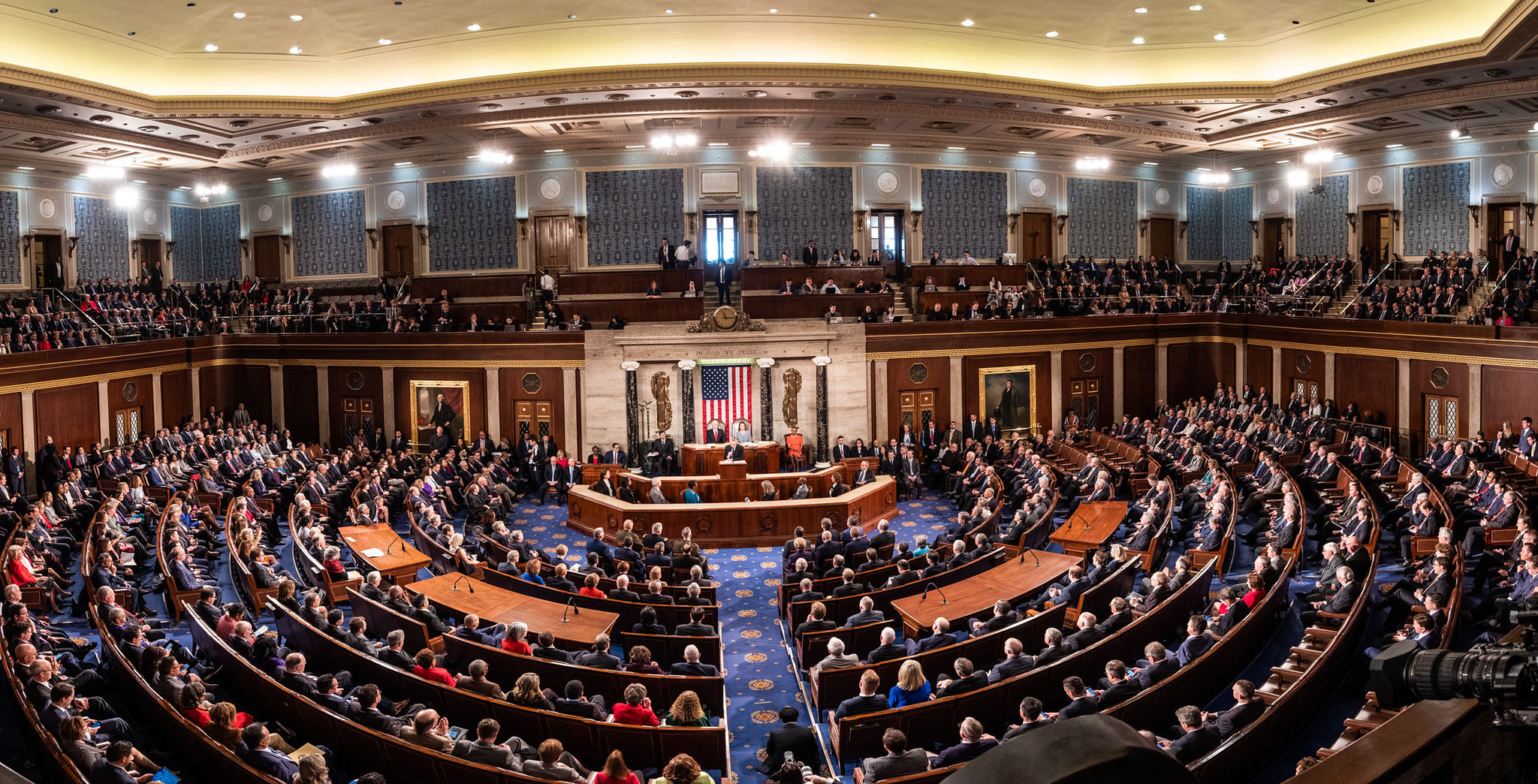
Democrats have taken control of both the U.S. House of Representatives and the Senate following the 2026 midterm elections, delivering a major political setback to President Donald Trump and ending the Republican Party’s control of Congress.
The victories, recorded in several traditionally Republican strongholds, mark the first time in 20 years that a Republican president has lost control of both chambers of Congress in a midterm election, following a similar setback for former President George W. Bush in 2006.
The outcome significantly weakens Trump’s legislative influence during the final two years of his second term, forcing his administration to negotiate with Democrats to advance major legislative proposals.
Before the November 3 elections, Republicans held a narrow majority in both chambers. In the 435-member House of Representatives, Republicans had 218 seats against 214 held by Democrats, with one independent member and two vacant seats.
The Senate, which has 100 members, was controlled by Republicans with 53 seats, compared with 45 Democrats and two independents who caucused with the Democratic Party.
However, the results have dramatically altered the balance of power. With several races projected in their favour, Democrats have secured at least 228 seats in the House against 139 for Republicans, with other contests yet to be called.
In the Senate, Democrats have secured 54 seats, including two independents who caucus with them, against 44 for Republicans, giving the party a clear majority in the upper chamber.
The figures reflect projections as results continue to come in, rather than the final certified totals. A party needs at least 218 seats to control the House and 51 seats to command a Senate majority.


Among the most significant Democratic victories were wins in traditionally Republican states, including Texas, Iowa, Kansas, South Carolina and Maine.
In Texas, Democrat James Talarico defeated Republican state Attorney General Ken Paxton to secure a Senate seat, marking the first time a Democrat has won a Senate election in the state since 1988.
Talarico described the victory as a David-versus-Goliath battle, crediting grassroots support for overcoming the financial and political resources mobilised against his campaign.
“We just proved that all the money in the world is no match for the people of Texas. We just showed that the politics of division is no match for the politics of love,” he said during his victory speech.
Texas also elected Democrat Gina Hinojosa as governor, defeating incumbent Republican Greg Abbott in another major upset for the party.
In Kansas, Democrat Adam Hamilton secured a Senate victory, ending a 94-year absence of Democratic representation from the state’s Senate delegation.
Democrat Troy Jackson also defeated incumbent Republican Senator Susan Collins in Maine, bringing an end to her 30-year tenure in the chamber.
Michigan recorded another significant victory for the Democrats, with Abdul El-Sayed defeating Republican Mike Rogers in the state’s Senate race. His election will make him the first Muslim to serve in the U.S. Senate.
The elections also produced other historic milestones, including the election of Keisha Lance Bottoms as the country’s first Black woman governor in Georgia and Chris Pappas as the first openly gay man elected to the Senate in New Hampshire.
Trump acknowledges defeat, blames Iran conflict
Reacting to the results, Trump acknowledged the Democrats’ performance, describing their campaign as a good one, while distancing himself from some Republican candidates who suffered defeats.
In an interview with Fox News, the president said he was surprised by the outcome but conceded that Democrats had campaigned effectively.
“The Democrats did a good job. They fought hard,” he said.
Trump also acknowledged that the ongoing conflict involving Iran contributed to the Republican losses, particularly through its impact on fuel prices and the cost of living.
“I think a part of it was Iran,” he said when asked about the factors behind the election outcome.
He added that although many Americans supported his position on Iran, the economic consequences of the conflict, particularly rising petrol prices, had affected voters’ decisions.
“People agree with what I’m doing on Iran but they really probably weren’t willing to do the short term consequences of paying more for gasoline – I understand that,” he said.
Despite accepting the results, Trump maintained that Republicans would have performed better had he personally been on the ballot.
In a post on his Truth Social platform, he declared that the party would have won “IN A LANDSLIDE!” if he had contested the election.
He also criticised Abbott, accusing the outgoing Texas governor of abandoning Republican principles in the final months of his political career.
Trump subsequently posted an image of a red cap bearing the word “VETO”, in an apparent reference to his constitutional authority to reject legislation passed by Congress.
In an interview with The New York Times, however, he said he was willing to accept the outcome and expressed readiness to work with the incoming Democratic congressional leadership.
“We’ll probably work something out,” he said.
What the Democratic takeover means for Trump
The Democratic victories will significantly change the political dynamics in Washington, particularly as Trump enters the final two years of his presidency.
With control of both chambers, Democrats will have greater influence over congressional proceedings, legislative priorities, government spending and oversight of the executive branch.
The party could also initiate investigations into the administration, including Trump’s business dealings, potential conflicts of interest involving his associates, and the Justice Department’s handling of the Jeffrey Epstein files. They also intend to scrutinise presidential pardons, government contracts and spending on projects linked to the president.
However, the election outcome does not remove Trump’s executive powers or automatically prevent him from implementing policies within his constitutional authority.
The president also retains the power to veto legislation passed by Congress. Overriding a presidential veto requires a two-thirds majority in both the House and Senate, a threshold Democrats are unlikely to command based on the emerging results.
The new congressional majorities are expected to take office on January 3, 2027, when the 120th Congress begins.