






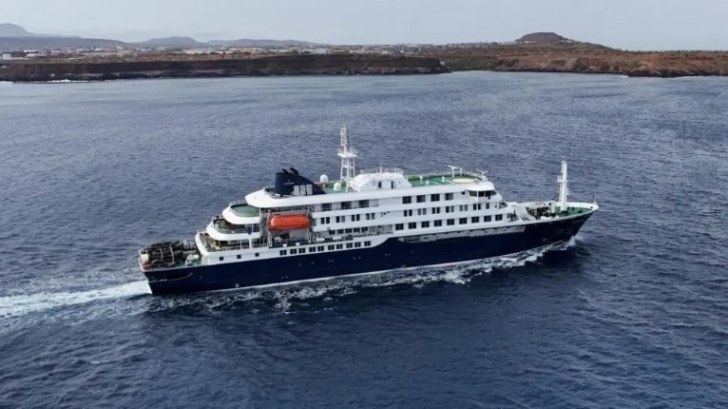
The expedition cruise vessel MV Hondius is at the centre of an international health scare following a hantavirus outbreak that has triggered medical evacuations, investigations into several deaths, and heightened monitoring across multiple countries.
The MV Hondius, operated by Oceanwide Expeditions, had remained anchored near Cape Verde for three days before departing for Tenerife under strict precautionary measures.
Two passengers in serious condition who were evacuated from the vessel have arrived in the Netherlands for treatment, while a third passenger remains in stable condition aboard a delayed evacuation flight.
The evacuees include British, Dutch and German nationals. Oceanwide Expeditions said the 65-year-old German passenger was “closely associated” with a German woman who died aboard the ship on May 2.
British passenger Martin Anstee, a 56-year-old former police officer identified by several media outlets, is reportedly in stable condition in the Netherlands. A 41-year-old Dutch crew member was also evacuated.
The outbreak has triggered concern across several countries after passengers who previously disembarked from the vessel travelled internationally.
Dutch media reported that a KLM flight attendant was hospitalised in Amsterdam after showing hantavirus symptoms following contact with a 69-year-old Dutch woman linked to the ship. The woman had briefly boarded a KLM flight in South Africa but was later denied travel because she was too ill to continue.
She subsequently died in South Africa on April 26, with authorities investigating whether hantavirus caused her death.
Three people connected to the cruise have died since the vessel departed Argentina about a month ago.
Health officials in the United States are also monitoring three passengers who returned home after leaving the ship earlier in the voyage. Authorities in Georgia confirmed that two residents under observation remain healthy and symptom-free, while Arizona health officials said another monitored individual is also not displaying symptoms.
The World Health Organization (WHO) confirmed that a man who returned to Switzerland after leaving the ship tested positive for hantavirus and is receiving treatment in Zurich.
“The patient had responded to an email from the ship’s operator informing the passengers of the health event,” WHO Director-General Tedros Adhanom Ghebreyesus said in a statement.
According to Oceanwide Expeditions, 146 people from 23 countries remain aboard the MV Hondius under “strict precautionary measures”.
WHO said eight hantavirus cases linked to the ship — three confirmed and five suspected — have so far been identified.
South African health authorities confirmed that tests carried out by the National Institute for Communicable Diseases detected the Andes strain of hantavirus in two confirmed patients. The strain is commonly found in Latin America, where the cruise began.
Medical experts have previously observed the Andes strain spreading between humans during past outbreaks, prompting authorities to intensify contact tracing efforts.
Officials said one of the deceased tested positive for the virus, while investigations continue into the other two deaths.
Among the fatalities is the 69-year-old Dutch woman who left the vessel during a stop at St Helena on April 24. Her husband had died aboard the ship on April 11, although his case has not been confirmed as hantavirus-related.
Another fatality involved a German woman whose body remains on the vessel pending further investigations.
Health authorities said none of the three medically evacuated passengers have so far tested positive for hantavirus, although two are displaying symptoms associated with the disease.
In the United Kingdom, the Health Security Agency confirmed that two British nationals who had previously left the ship are self-isolating at home following possible exposure. Neither has shown symptoms.
Oceanwide Expeditions previously disclosed that the ship carried 19 British passengers and four British crew members, including Anstee.
Health experts believe the outbreak may have spread through close human contact rather than the more common rodent transmission associated with hantavirus.
Dr Maria Van Kerkhove of the WHO stressed that transmission patterns differ significantly from airborne illnesses.
“We’re not talking about casual contact from very far away from one another,” she said, but “really physical contact”.
Spanish authorities have approved the ship’s journey to Tenerife, where all passengers and crew will undergo medical screening upon arrival.
Spain’s Health Minister Mónica García said foreign nationals deemed healthy enough to travel would be repatriated to their home countries, while Spanish citizens would be quarantined at a defence hospital in Madrid.
The evacuation process would “avoid contact” with Canary Islands residents and there would be “no risk” to the public, García said.


However, Canary Islands President Fernando Clavijo criticised the decision to allow the ship to dock.
“I cannot allow [the boat] to enter the Canaries,” he told Spain’s Onda Cero radio station. “This decision is not based on any technical criteria and nor have we been given enough information.”
Investigations and testing aboard the ship remain ongoing as health authorities continue monitoring possible cases linked to the outbreak.
Source: BBC